13.3 Orbital Mechanics and Satellites

Satellites

Satellites

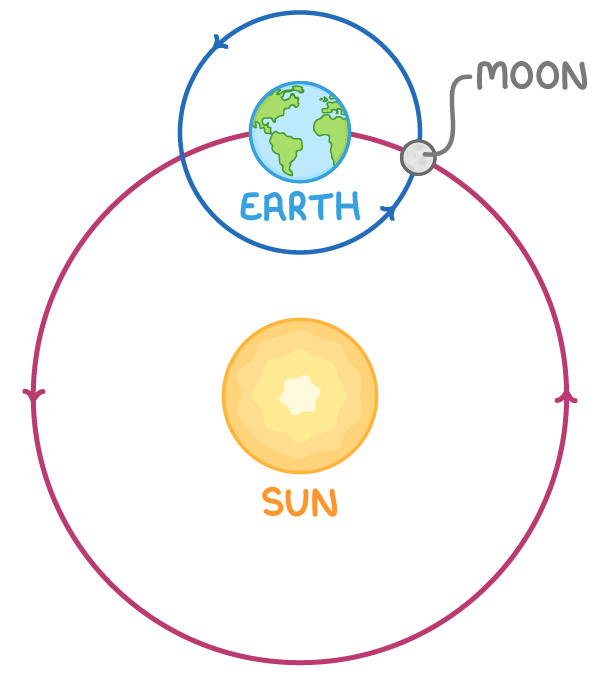
A satellite is a mass that orbits (moves in circular motion) around a larger mass.

The Earth is a satellite orbiting the Sun and the Moon is a satellite orbiting the Earth.

How does a satellite stay in orbit?

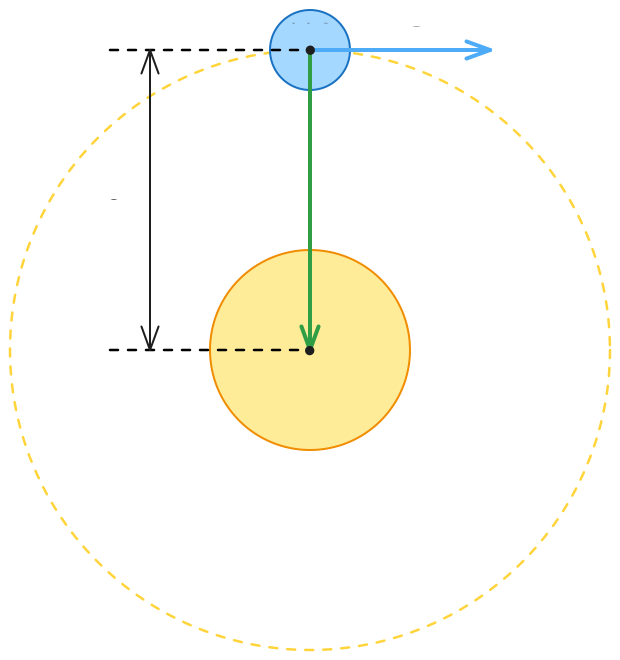
  • The gravitational force between the satellite and the mass which it orbits provides the centripetal force needed to keep the satellite moving in circular motion around the mass.

Gravitational Force as Centripetal Force

A satellite of mass m orbiting a mass of mass M

Danger

  • When using gravitation force as centripetal force in a derivation, make sure to state that:
  • And then:

Orbital Velocity

Derivation of Orbital Velocity ( )

  • Explicitly state that:
  • Equate Gravitational Force and Centripetal Force:
  • Simplify and make subject:

Orbital Period

Derivation of Orbital Period ( )

  • Explicitly state that:
  • Equate Gravitational Force and Centripetal Force:
  • Simplify:
  • Substitute :
  • Simplify and make subject:

Kepler's Third Law of Planetary Motion

Geostationary Orbit

Geostationary Orbit

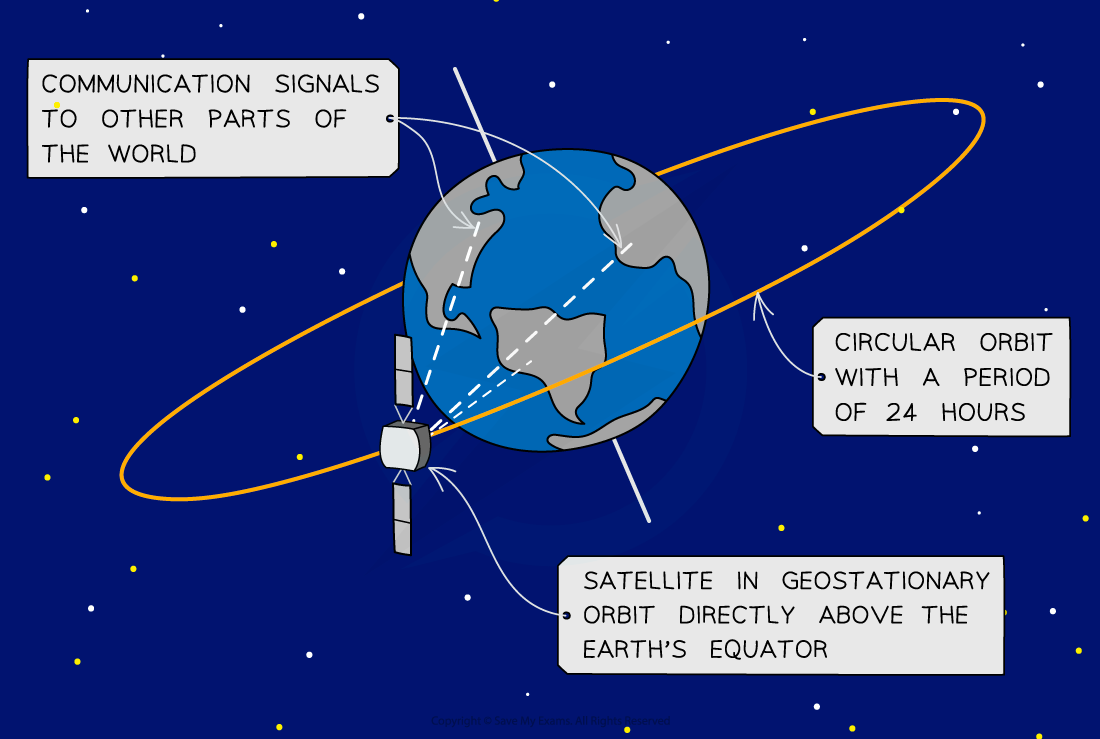
A geostationary orbit is one in which the orbiting satellite is always above the same point on Earth.

A telecommunications satellite orbiting the Earth

Conditions for Geostationary Orbit

  • Orbital period of exactly 24 hours.
  • Orbits from West for East.
  • Orbits directly above the Equator.

Chapter 13: Gravitational Fields (3/X) Previous Note: 13.2 Gravitational Force between Point Masses Next Note: 13.4 Binary Star System