A thermometric property is physical property that changes in a predictably with temperature
Examples of Thermometric Properties
Density of a liquid.
Volume of a gas at constant pressure.
Resistance of a metal or thermistor
E.M.F. of a thermocouple
Thermometers
Thermometer
A thermometer is a device used to measure temperature.
A thermometer makes use of a thermometric property of a given material.
1. Liquid-in-glass Thermometer
Liquid-in-glass Thermometer
Relies on the change in density (expansion) of a liquid (e.g. alcohol or mercury)
Liquid in glass thermometer
2. Resistance Thermometers and Thermistors
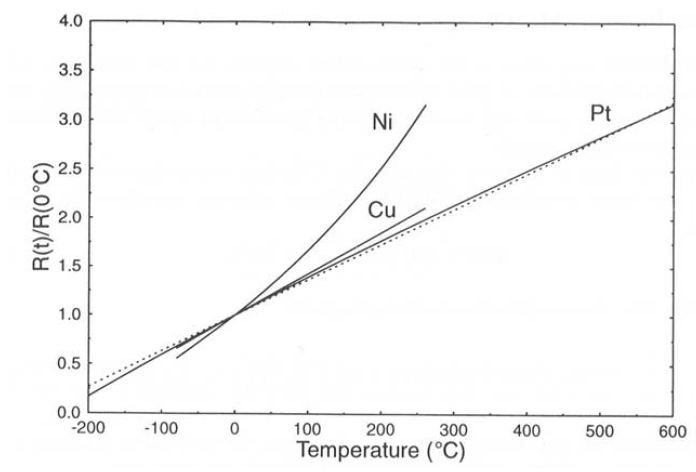
Metal Resistance Thermometer (e.g. Platinum)
Electrical resistance increases linearly with temperature.
Variation of resistance of different metals with temperature
Thermistors (NTC)
Resistance changes rapidly and non-linearly over a narrow range of temperatures.
As the thermistor gets hotter, its resistance decreases.
Thermistor Graph
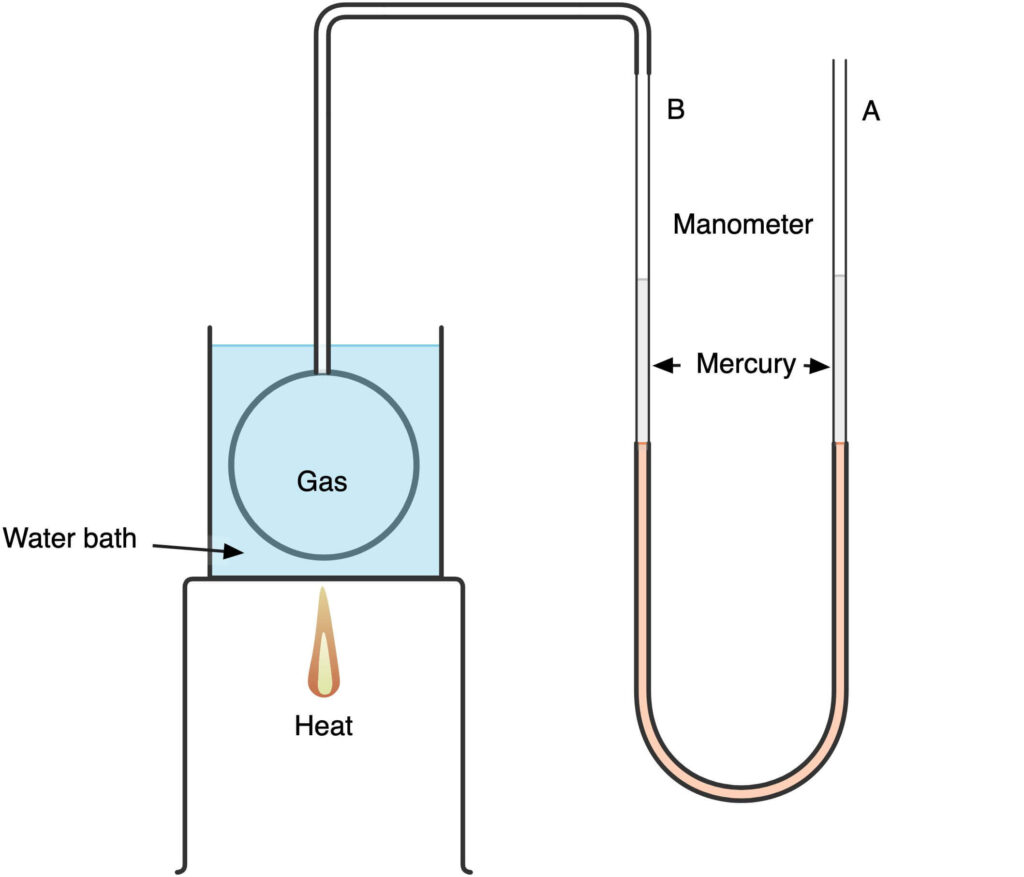
3. Constant Volume Gas Thermometer
Constant Volume Gas Thermometer
It is a highly precise instrument that measures temperature by observing the change in pressure of a fixed mass of gas kept at a constant volume.
Directly measures thermodynamic temperature
Gas thermometer
Principle of Operation
The thermometer relies on Gay-Lussac’s Law, which states that for a fixed mass of an ideal gas at constant volume, the pressure is directly proportional to its thermodynamic temperature:
P∝T
Therefore, if you can measure the pressure p of the gas, you can determine its absolute temperature T:
T=constant×p
Advantages
Directly measures thermodynamic temperature (kelvin).
Most accurate thermometer.
Operates over a wide range of temperatures.
Used to calibrate other thermometers.
Disadvantages
Large Thermal Mass / Slow Response Time: The large glass bulb and gas inside take a long time to reach thermal equilibrium with their surroundings.
Cannot Measure Rapidly Changing Temperatures: Because of the slow response time.
Alters the Object’s Temperature: It cannot be directly used to measure the temperature of small objects. The large thermal capacity of the bulb would draw too much thermal energy away from the object.
Important
Not just any gas can be used. The gas must approximate and ideal gas as closely as possible.
As such, helium is the most suitable gas.
4. Thermocouple
Thermocouple
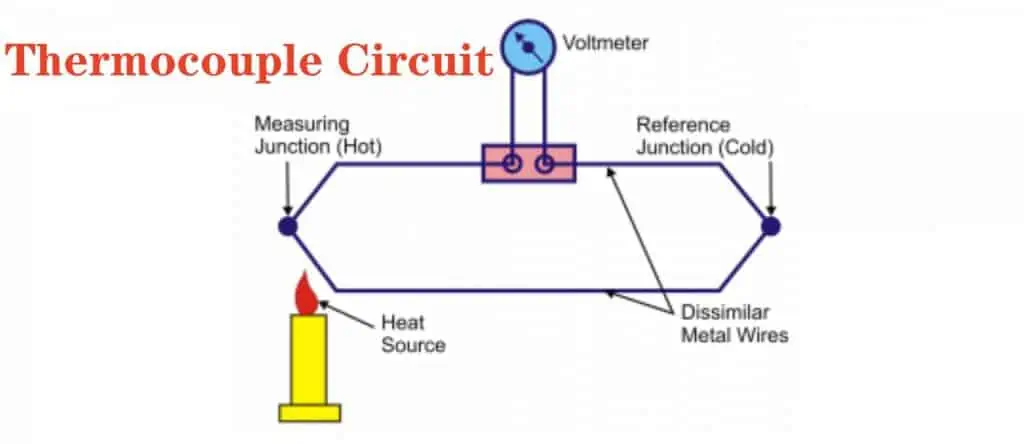
Consists of two dissimilar metals (different metals) joined at two junctions.
When there is a temperature difference between the two junctions, an e.m.f is produced.
One junction is used to measure temperature while the other is at a reference temperature, typically 0∘C (pure melting ice).
Thermocouple Circuit
Advantages
Fast response time.
Can measure rapidly changing temperatures.
Can measure very high temperatures.
Small thermal capacity (does not absorb much thermal energy from object being measured).