Collisions between molecules and walls of container are perfectly elastic.
The volume of molecules of gas is negligible compared to volume of gas.
The time of a collision is negligible compared to the time between collisions.
There is a very large number of molecules that move randomly (allowing statistical averages to be used).
How Molecules Exert Pressure
How do molecules exert a pressure on the walls of a container?
Molecules collide with the walls of the container.
The momentum of the molecule changes during the collision.
By Newton’s second law, this rate of change of momentum causes a force on the molecule by the wall.
By Newton’s third law, the molecules exert an equal and opposite force on the wall.
Many molecules exerting forces across the area of the wall leads to an average pressure (p=AF)
Derivation of pV=31Nm⟨c2⟩
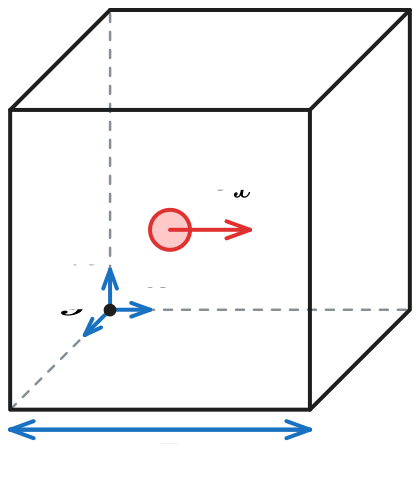
Imagine a single ideal gas particle inside a cubical box of side length L:
An ideal gas particle inside a cubical box
The particle has mass m
The component of the particle’s velocity in the x direction is cx
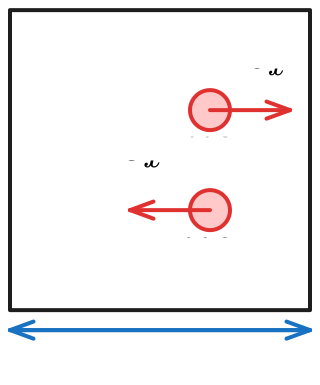
The particle moves to the right and hits the wall of the box and rebounds elastically:
Particle hits right wall and rebounds
Before hitting the wall, the initial velocity pinitial of the particle is cx
After it rebounds elastically, it moves in the opposite direction with same magnitude of velocity (kinetic energy conserved in elastic collision).
The final velocity pfinal is −cx
The change in momentum of the particle is given by:
Δp=pfinal−pinitial=−mcx−mcx=−2mcx
The change in momentum of the wall is:
Δp=2mcx
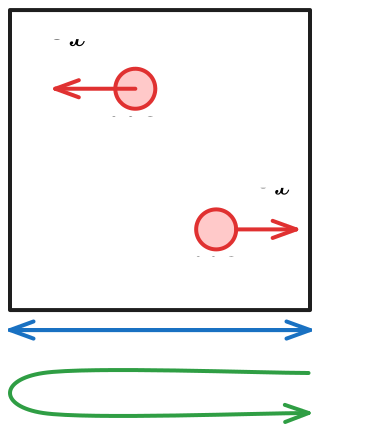
The particle hits the left wall, rebounds, and come back to hit the right wall again.
Particle hits left wall and rebounds
The time between two collisions with the right wall is given by:
Time,Δt=timedistance=cx2L
From Newton’s Second Law, Force is the rate of change of momentum:
F=ΔtΔp=2mcx÷cx2L=2mcx×2Lcx=Lmcx2
Why do we use time between collisions?
Why is the time in F=ΔtΔp taken as the time between collisions instead of the time of the collision itself?
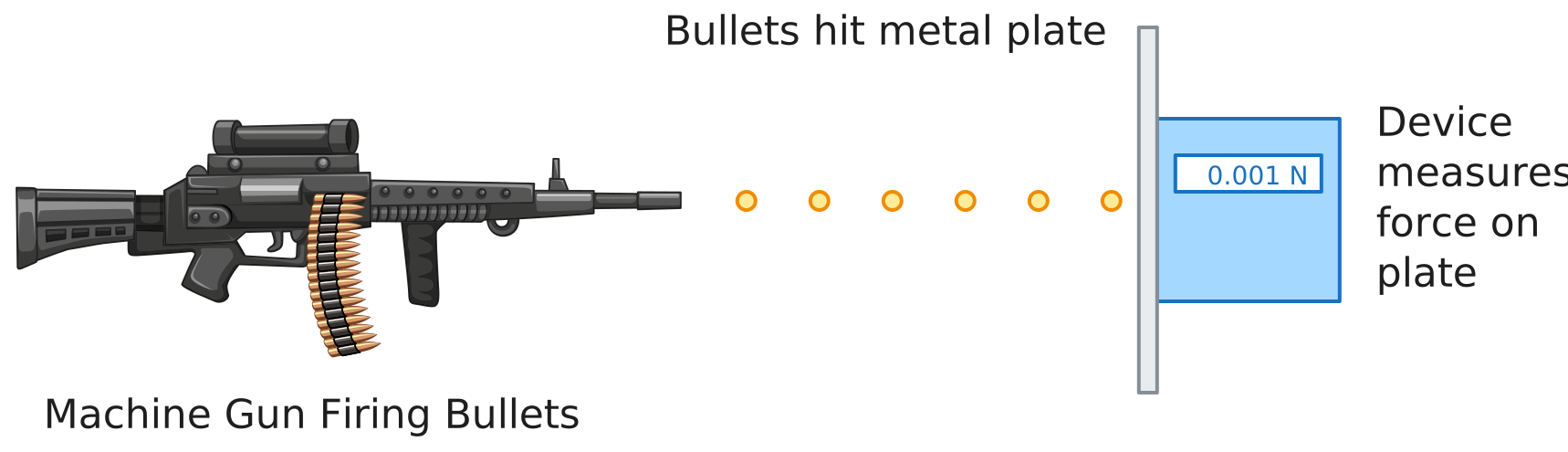
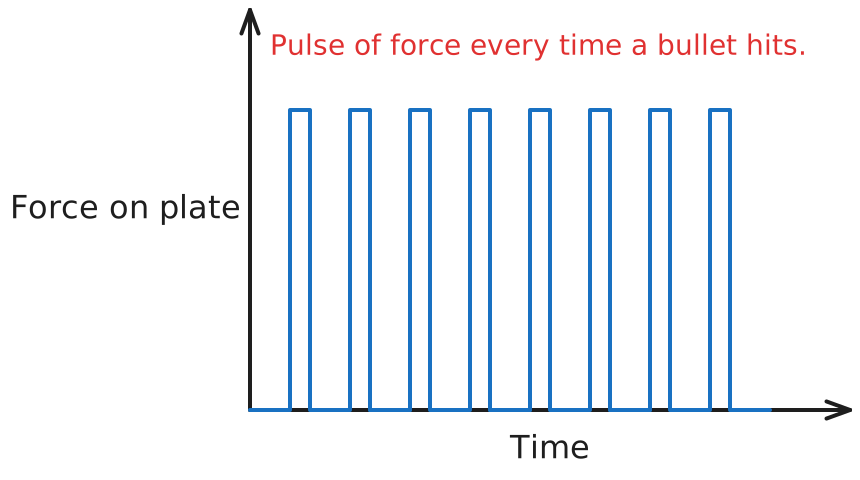
Imagine a machine gun firing bullets at a metal plate:
A machine gun firing bullets at a plate
If a device measures the force felt by the plate, a graph of force against time would look like this:
A graph of force against time
Each time a bullet hits, there is a sharp spike in force, followed by zero force until the next bullet arrives.
To find the average constant force exerted on the plate by the bullets, we would take the total change in momentum from a large number of bullets (n) and divide it by the total time elapsed.
Similarly, when ideal gas particles hit the wall of a container, each impact creates a brief spike in force. Because we want to calculate the constant macroscopic pressure of the gas, we need to find the average constant force on the wall. We apply the exact same logic: we divide the total change in momentum from a large number of particle collisions (n) by the total time taken:
Faverage=ΔttotalΔptotal
Let’s say the change in momentum from a single collision is Δp. For a large number of collisions n, the total change in momentum is:
Δptotal=n×Δp
The total time taken for these n collisions is simply the time between consecutive collisions (Δt) multiplied by n:
Δttotal=n×Δt
Substituting these into our average force equation gives:
Faverage=n×Δtn×Δp
Notice how the n‘s cancel out:
Faverage=ΔtΔp
This proves that the average force of billions of collisions is mathematically identical to taking the momentum change of just one collision and dividing it by the time between collisions.
Pressure is defined as force per unit are:
p=AF=Lmcx2÷L2=Lmcx2×L21=L3mcx2
Since L3 is the volume of the cubical box:
p=Vmcx2
This gives us the pressure exerted on the wall by one particle.
For pressure exerted on wall by N particles, we add up the individual pressures:
Rearranging to make cx12+cx22+cx32+⋯+cxN2 subject:
cx12+cx22+cx32+⋯+cxN2=N⟨cx2⟩
Substituting in the equation from step 10:
p=Vm×N⟨cx2⟩=VNm⟨cx2⟩
The average squared velocity is given by the sum of the squares of the 3 components of velocity along the x, y, and z directions:
⟨c2⟩=⟨cx2⟩+⟨cy2⟩+⟨cz2⟩
Since there is a very large number of particles moving randomly in all directions (isotropic system), the components of velocity in the 3 dimensions can be approximated as being equal:
⟨cx2⟩≈⟨cy2⟩≈⟨cz2⟩
Therefore the squared velocity is given by:
⟨c2⟩=⟨cx2⟩+⟨cx2⟩+⟨cx2⟩=3⟨cx2⟩
To make ⟨cx2⟩ subject:
⟨cx2⟩=31⟨c2⟩
Substituting in equation from step 11:
p=VNm×31⟨c2⟩=V31Nm⟨c2⟩
Multiplying by V on both sides:
pV=31Nm⟨c2⟩
Since Nm is the total mass of N molecules, and density ρ is given by ρ=VolumeMass, the equation can be written as:
p=31ρ⟨c2⟩
Where ρ is the density of the gas.
Root-Mean-Square (r.m.s) Speed
R.M.S Speed
The root-mean-square speed is the square root of the mean square speed:
cr.m.s=⟨c2⟩