In Simple Harmonic Motion, frequency is constant, therefore angular frequency (ω) is also constant.
Negative sign shows that acceleration is in opposite direction of displacement.
Restoring Force
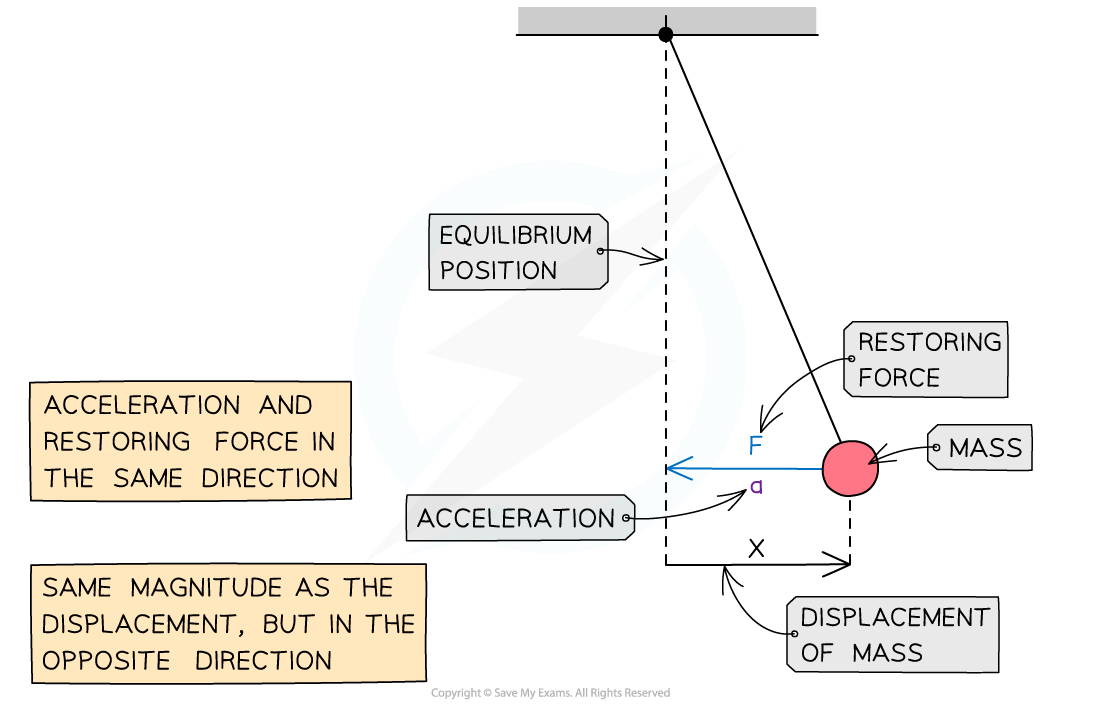
The restoring force is the force responsible for SHM.
It Always acts in the opposite direction of displacement and in same direction as acceleration.
Pendulum SHM Restoring Force
Showing that a given motion is Simple Harmonic
To show that a given motion is Simple Harmonic Motion, the equation describing it should be able to be represented in the form a=−kx, where k is a constant and equal to ω2.
If given a a−x graph, it should be a straight line passing through the origin with negative gradient.
What is not SHM?
Any motion that does not obey the relation a∝−ω2x is not Simple Harmonic.
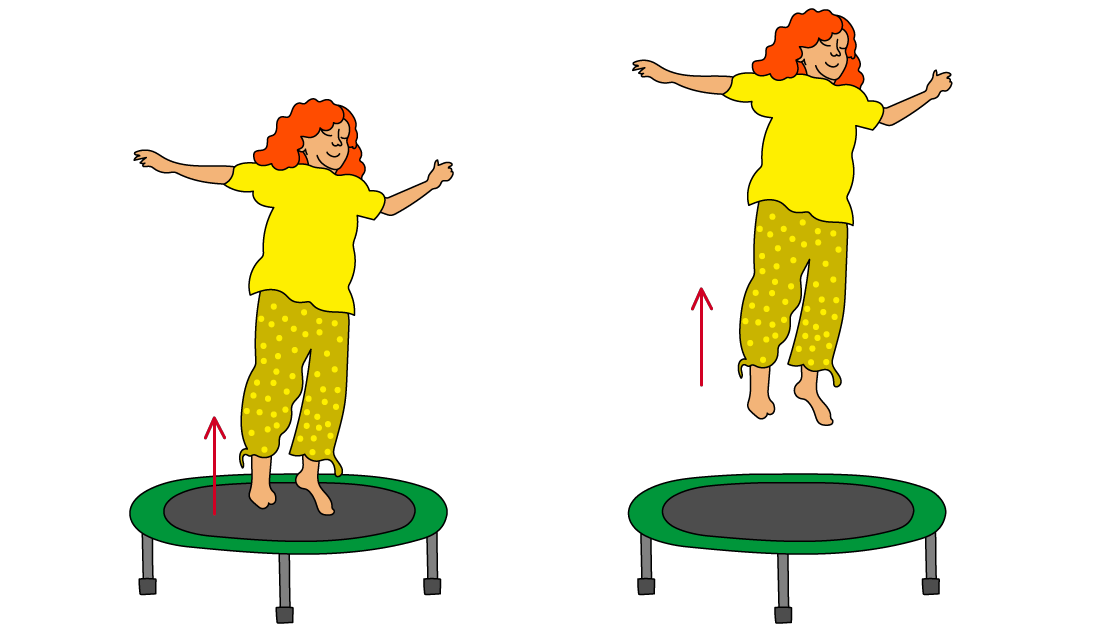
Example: Person jumping on trampoline
A person jumping on a trampoline is not SHM.
When the person is in the air, the only force acting is their weight, which is constant (W=mg).
Because the restoring force is not proportional to displacement, it breaks the definition of SHM.