An electric field is an example of a field of force.
It is a region of space where a stationary electric charge experiences a force.
Electric Field Strength ( E)
Electric field strength at a point is defined as the:
Force per unit positive chargeE=qF
Unit:NC−1 or Vm−1
Vector Quantity: It has both a magnitude and direction.
The direction of the field is the direction of the force on a positive charge
Electric Force
Using the equation for field strength, the force on a charge in an electric field is given by:
F=Eq
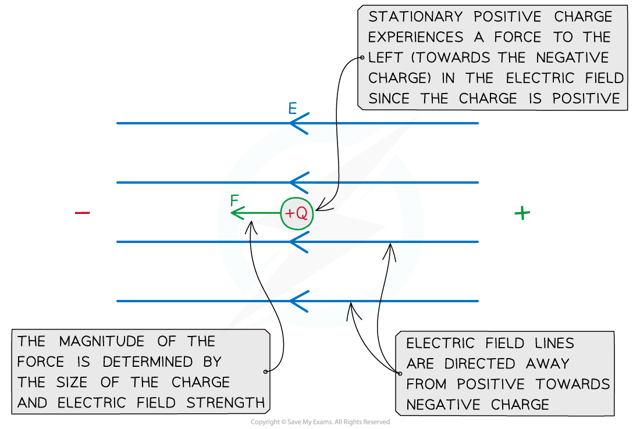
A positive charge experiences a force of magnitude Eq in the same direction as the electric field.
A negative charge experiences a force of magnitude Eq in the opposite direction as the electric field.
A positive charge Q in an electric field of strength E experiences a force F in the direction of the field.
Critical: Definition of Electric Field
The definition of Electric Field is the same as for Electric Field Strength
Concept: Field of Force
A field of force is a region in space
Where a particle experiences a force
Representing Electric Fields
Rules of Construction
Field lines are a visual representation of the vector field E:.
These 4 rules must be adhered to when drawing field lines:
Direction: Arrows on lines indicate the direction of force on a stationary positive test charge.
Magnitude: Represented by the density of lines.
Lines closer together → Stronger field
Lines further apart → Weaker field
Surface Contact: Field lines must meet the surface of a conductor at 90∘ (perpendicular).
Reasoning: If they were not perpendicular, there would be a component of force along the surface, causing electrons to move. In electrostatics, charge is stationary, so the tangential force must be zero.
Non-Intersection: Field lines can never cross.
Reasoning: If they crossed, a particle at the intersection would experience two different directions of force simultaneously, which is impossible.
Standard Field Patterns
A. Point Charges (Radial Fields)
A radial field has a field strength that depends on distance (E∝r21).
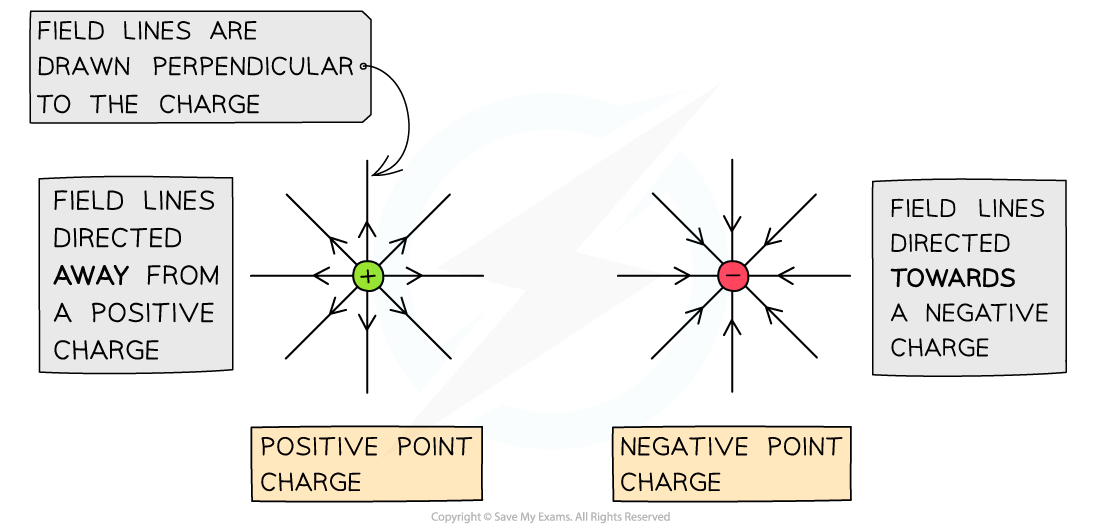
Positive Charge (+q): Field lines diverge radially outwards.
Negative Charge (−q): Field lines converge radially inwards.
Spacing: The separation between lines increases as distance increases, visually representing the Inverse Square Law.
Electric field lines around a point charge are directed away from a positive charge and towards a negative charge.
B. Conducting Spheres (Hollow)
The Hollow Sphere Rule
For a charged spherical conductor:
Outside (r>R): The field lines are radial and behave exactly as if all charge were concentrated at the centre:
Field lines are normal to the surface of the sphere and appear to diverge from the centre (for positive charges) or converge onto the centre (for negative charges).
Inside (r<R): The Electric Field Strength is zero. There are no field lines inside.
Electric field lines around a charged conducting sphere are similar to the field lines around a point charge.
C. Uniform Electric Field (Parallel Plates)
Formed between two parallel metal plates with opposite charges.
Pattern: Parallel, equally spaced straight lines running from the positive plate to the negative plate.
Significance:E is constant everywhere in this region.
Edge Effect: At the edges of the plates, the lines curve outwards (“fringing”).
Electric field lines between two parallel plates are directed from the positive to the negative plate. A uniform electric field has equally spaced field lines.
Deep Dive: Fringing at edges explained
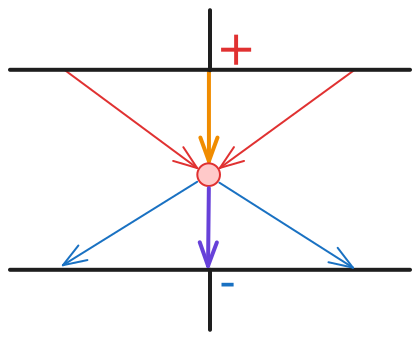
Imagine two parallel oppositely charged metal plates and a positive test charge in the middle:
1. The Central Region (Symmetry)
In the centre of the plates, the charge distribution is symmetric.
A test charge is surrounded by equal amounts of positive charge on its left and right on the top plate.
The horizontal components of repulsion cancel out perfectly.
The net force is purely vertical. The field lines are straight and parallel
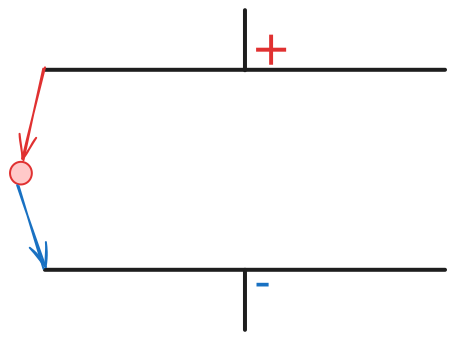
2. The Edge Region (Asymmetry)
At the edge, there is a sudden loss of symmetry.
The “Push” Out: Near the top (+) plate, there is a large concentration of charge inside the gap pushing the test charge down and outwards. There is no charge on the outside to push it back.
The “Pull” In: As the field line approaches the bottom (-) plate, the charge inside the gap attracts the test charge inwards.
Result: The vector sum of these forces creates a curved trajectory. The field line bulges out to relieve the “lateral pressure” from the internal field lines.
C. Interaction between Two Charges
1. Opposite Charges (Dipole): Attraction
Lines originate from the positive charge and terminate on the negative charge.
Lines in the centre are dense (strong field).
The electric field lines between two opposite charges are directed from the positive to the negative charge. The field lines connect the surfaces of the charges to represent attraction.
2. Like Charges: Repulsion
Field lines are directed away from two positive charges or towards two negative charges.
Lines do not touch or cross.
Neutral Point: A region exists at the midpoint of the two charges were no field lines pass.
At this point, the vector sum of field strengths is zero (Enet=0).
The electric field lines between two like charges are directed away from positive charges or towards negative charges. The field lines do not connect the surfaces of the charges to represent repulsion.
D. Electric field between a point charge and parallel plate
The field around a point charge travelling between two parallel plates combines
The field around a point charge
The field between two parallel plates
The electric field lines between a point charge and a parallel plate are similar to the field between two opposite charges. The field lines become parallel when they touch the plate.