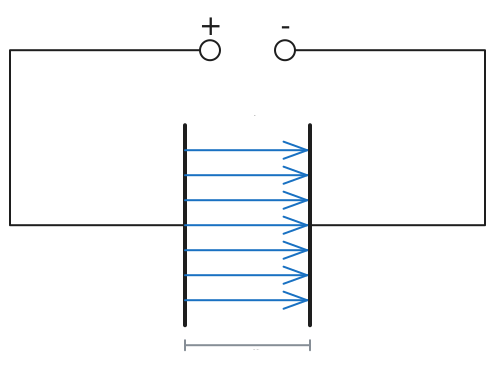
A potential diffrerence, \Delta \mathrm{V} applied across two metal plates.
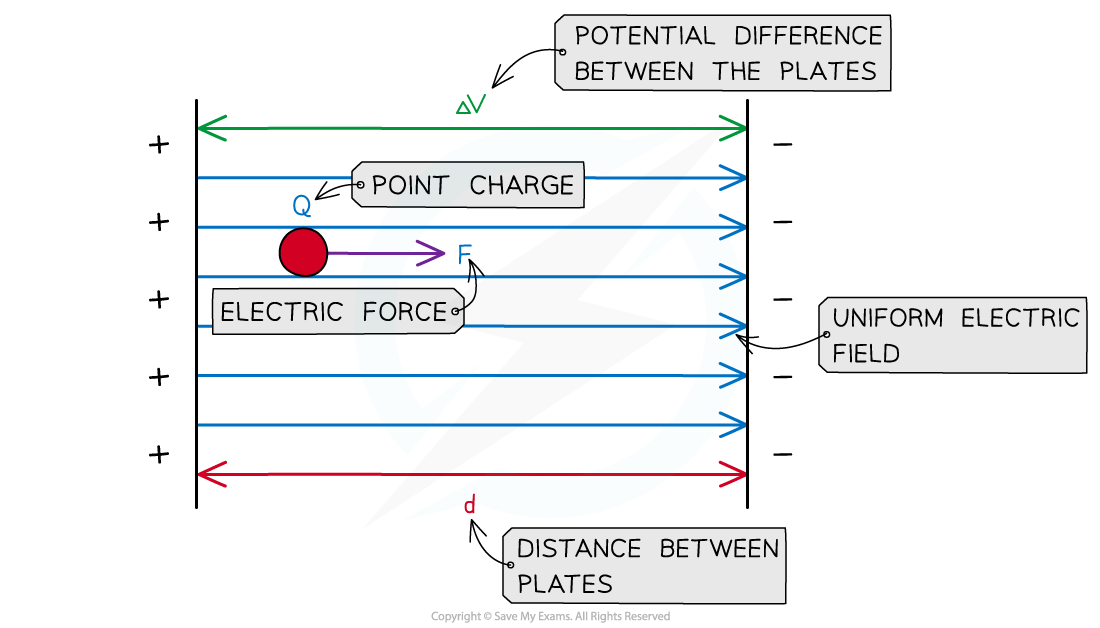
When a potential difference, ΔV, is applied across two metal plates, a uniform electric field is formed between them:
The field lines are equally spaced and parallel.
A point charge placed anywhere inside this uniform field experiences the same electric field strength and force.
Consider a positive test charge with charge q placed just next to the positive plate:
The charge q experiences a force F that accelerates it towards the negative plate.
The separation of the two plates is Δd.
The work done, W, by the force F in accelerating the charge q to the negative plate is given by:
W=FΔd The work done in moving a charge from one plate to another depends on the potential difference and distance.
The potential difference, ΔV, across the plates is defined as the work done per unit positive charge in moving a charge q from one plate to another:
ΔV=qW
This relationship can be rearrange to make the work done subject of formula:
W=qΔV
We have W=FΔd, W=qΔV and from the definition of electric field strength: F=qE. Putting these together:
FΔdEqΔdEΔdE=qΔV=qΔV=ΔV=ΔdΔV
Therefore, the electric field strength of a uniform electric field between two plates is given by:
E=ΔdΔVUnits:Vm−1 or NC−1
Motion of Charged Particles in a Uniform Field
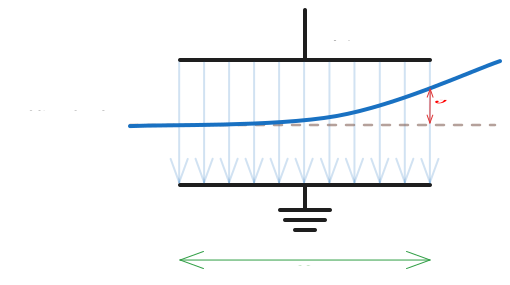
Consider a horizontal beam of electrons (negatively charged) travelling at constant speed into a uniform electric field created between two horizontal parallel metal plates in a vacuum:
The path of electrons entering a uniform electric field.
Critical
The path of the electrons outside the electric field (before entering and after exiting the plates) is a straight line.
The electron continues through the field with a constant horizontal component of velocity, vx.
The electron’s vertical component of speed, vy, increases due to the acceleration produced by the upwards force F exerted on the electron by the electric field.
The force F experienced by a charged particle in the electric field is given by:
F=Eq
From Newton’s Second Law:
Faa=ma=mF=mEq
The time, t, for a particle to travel the length, x, of the plates is given by:
t=horizontal velocitydistance=vxx
Since the acceleration is constant, the equation s=ut+21at2 can be used to determine the vertical displacement, y.
Since the initial vertical velocity of the particle is zero, the equation can be rewritten as s=21at2:
sy=21at2=21×mEq×(vxx)2
The equation v=u+at can be used to determine the vertical velocity, vy, of the particle as it leaves the electric field, since initial vertical velocity is zero, the equation can be rewritten as v=at:
vvy=at=mEq×vxx
Worked Example
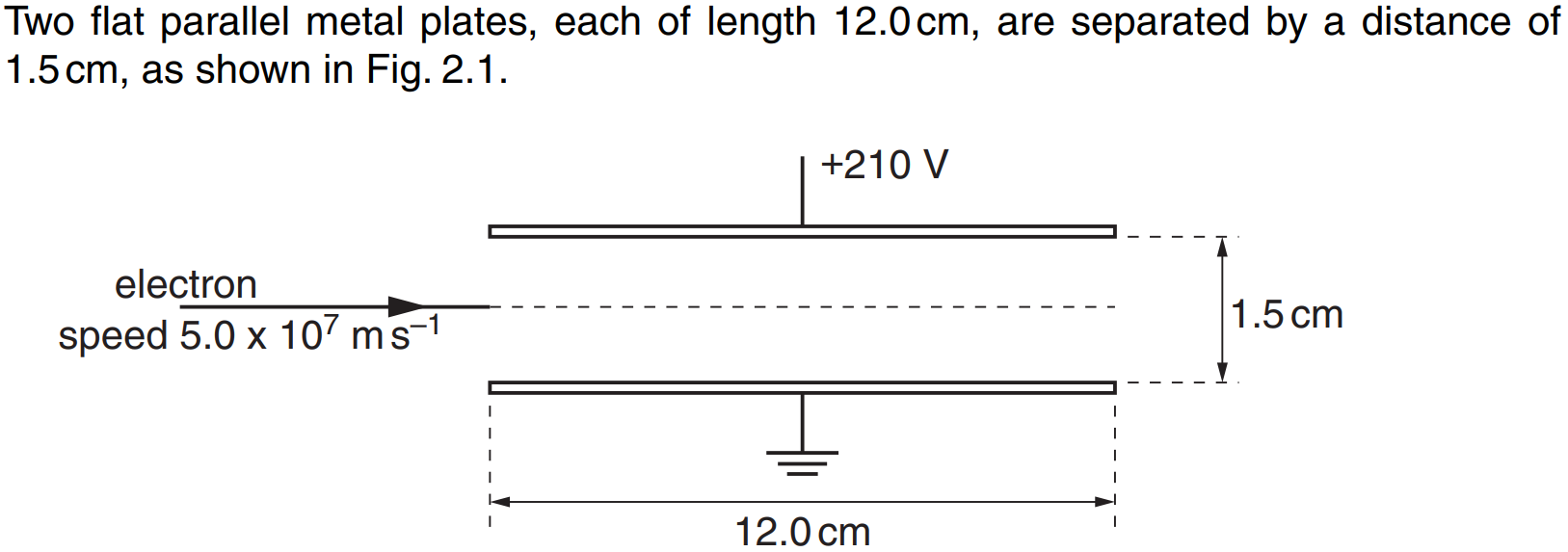
9702_s07_qp_2, Question 2Determine whether the electron will emerge from between the two plates or will hit the top plate.
Logic: We need to determine the vertical displacement, y, of the electron as it leaves the plates:
If the vertical displacement is greater than the distance from the centre line to the top plate, the electron hit the top plate.
If the vertical displacement is smaller than the distance from the centre line to the top plate, the electron emerges from between the plates.
Step 1: Calculate the time, t, for the electron to travel the length of the platestt=vxlength of plate=5.0×1070.120=2.4×10⁻⁹sStep 2: Calculate the vertical accelerationFaFaEa=ma=mF=Eq=mEq=ΔdΔV=me(ΔdΔV)×e=9.11×10⁻³¹(0.015210)×1.6×10-19=2.459×10¹⁵ms−2Step 3: Calculate the vertical displacements=21at2=21×2.459×1015×(2.4×10−9)2=7.1×10⁻³mStep 4: Conclusion
Since the vertical displacement of the electron as it leaves the plates (7.1×10⁻³) is less than the distance from the centre line to the top plate (7.5×10⁻³), ∴ the electron emerges from between the plates.