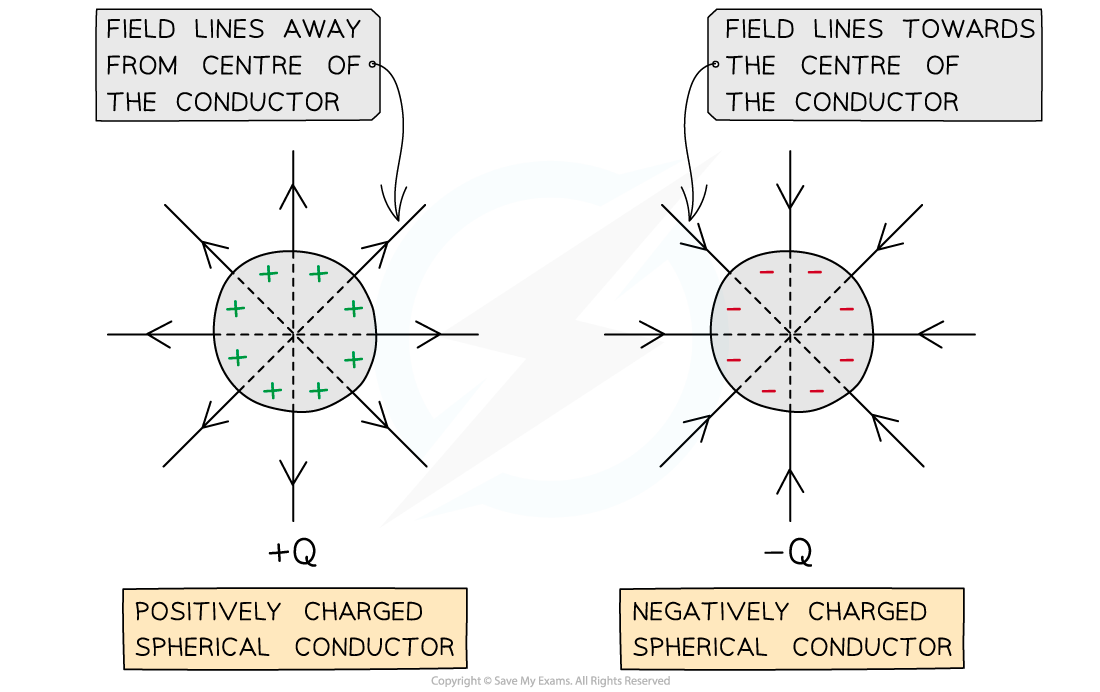
In electrostatics, we rarely deal with infinitesimally small “points”, we deal with charged spheres.
The point charge assumption
For any point outside a spherical conductor, the charge on the sphere is treated as if it were a single point charge at the sphere’s centre.
The electric field lines around a spherical conductor are therefore identical to those around a point charge.
Electric field lines around a uniform spherical conductor are identical to those on a point charge
Coulomb’s Law
Statement of Coulomb's Law
The electric force between two point charges is directly proportional to the product of their charges and inversely proportional to the square of their separation.
The Equation
From Coulomb’s Law:
FF∝r2Q1Q2=kr2Q1Q2
Where k is the constant of proportionality, k=8.99×10⁹mF−1, provided that the charges are in a vacuum.
However, if the charges are in air rather than a vacuum, the change to the value of k is negligible, therefore k=8.99×10⁹mF−1 can still be used.
The value k can be expressed in terms of another constant:
k=4πϵ∘1
Where ϵ∘ is the permittivity of free space, ϵ∘=8.85×10⁻¹²Fm−1.
The constant ϵ∘ relates the electric field tot he magnetic field and the propagation of electromagnetic waves.
Newton’s Third Law Application
The force exerts a symmetrical effect,
∣FQ1onQ2∣=∣FQ2onQ1∣
Even if Q1=+1C and Q2=+1000C, the force felt by the small charge is exactly the same magnitude as the force felt by the large charge.