Electric Field Strength of a Radial Field
- Unlike the uniform field between plates (), the field around a point charge (or spherical conductor) is radial and non-uniform.
- Its strength decreases rapidly with distance (inverse square law).
Formula: Radial Field Strength
The electric field strength at a distance from a point charge is:
- : Electric Field Strength (N C or V m)
- : Magnitude of the source charge (Coulombs, C)
- : Distance from the centre of the charge (Metres, m)
- : Permittivity of Free Space ( F m)
Derivation from Coulomb’s Law
- Recall the definition of electric field strength: Force per unit positive charge:
- Recall Coulomb’s Law for the force between source charge, , and test charge, :
- Substitute :
Vector Nature
- is a vector.
- If is Positive: points radially outwards (Repels a test charge).
- If is Negative: points radially inwards (Attracts a test charge).
Graphical Representation (Inverse Square Law)
The graph of against is an Inverse Square Relationship ().
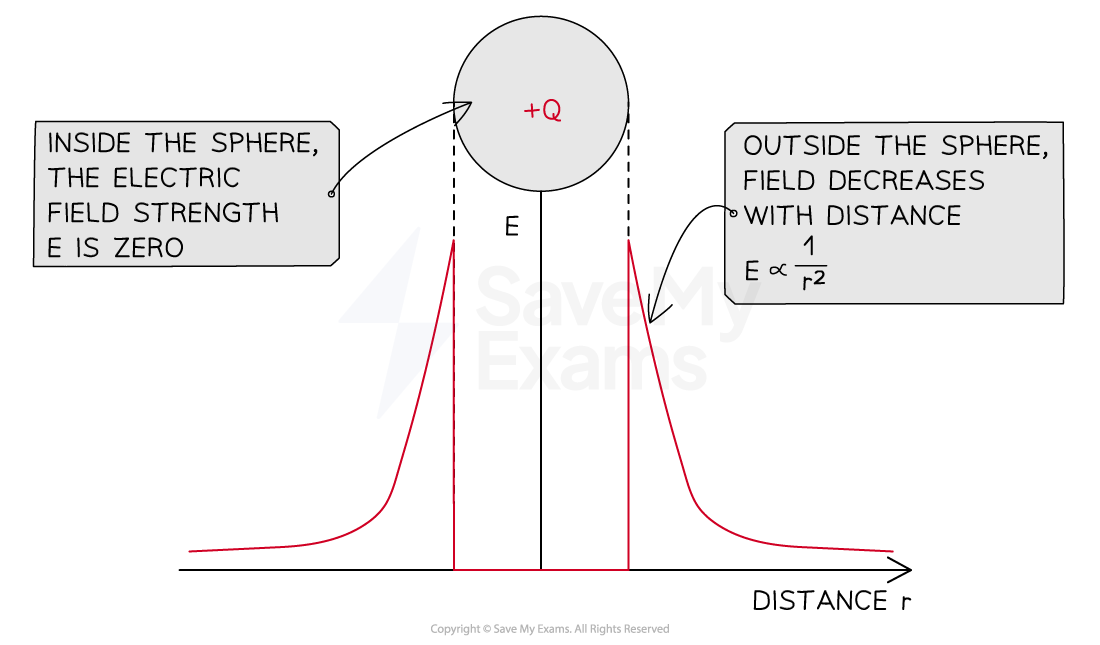
Sketching the Graph
Scenario: A positively charged conducting sphere of radius .
- Region : (Inside a conductor).
- At : (Maximum value at the surface).
- Region : Curve decays rapidly.
- At , field is .
- At , field is .
- The curve is asymptotic to the r-axis (never touches 0).
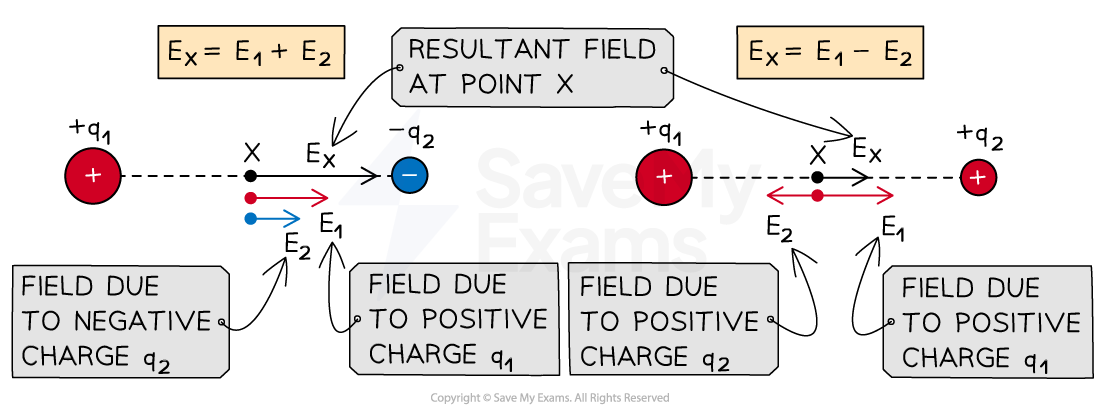
Superposition of Electric Fields
For multiple charges, the total field strength at a point is the vector sum of the individual field strengths:
Isolation of Variables (Ratio Questions)
Formula for ratio of new/old charge and distance
Formula
Derivation
Example
At a distance of from a charge , the electric field strength is . What is the field strength at a distance from a charge ?
Method:
Common Mistakes
- Square the Distance: Remember to square the distance.
- Radius vs Distance: If asked for the field at a height above a sphere of radius , the distance is .