Definition of Electric Potential ()
Definition
The electric potential at a point is defined as the work done per unit positive charge in brining a small test charge from infinity to the point.
Unit: Volt () or . Nature: Scalar The Reference Point: Infinity is defined as the point of zero potential.
Critical: Electric Potential is scalar
- Potential does not have to be resolved into components (vectors).
- You simply add them: This does not mean that potential cannot be negative!
Electric Potential of a Point Charge
For an isolated point charge , the potential at a distance is given by:
Precision: Signs Matter!
Unlike Force or Field Strength where we often calculate magnitude and decide direction later, for Potential you must substitute the sign of the charge.
Source Charge Potential
()Meaning Positive
()Positive
()Work must be done by an external agent to push a positive text charge against repulsion. Negative
()Negative
()Work is done by the field to pull a positive test charge in (Potential Well).
Graphical Representation
TODO: Add graphs
Graph
- Shape: Rectangular Hyperbola ().
- Comparison: It falls off slower than Field Strength ().
- At surface (): .
- Inside a Conductor (): Potential is constant.
Relationship between Field Strength and Potential
Relationship
Electric Field Strength is the negative potential gradient.
- Negative Sign: Indicates that the field lines point in the direction of decreasing potential (High Potential Low Potential).
Graphical Representation
TODO: Add graphs
Graph
- The Gradient of a graph is .
- The Area under an graph is .
Electric Potential Energy
If Electric Potential is “work done per unit charge”, then Electric Potential Energy is the total work for a specific charge .
Electric Potential Energy
Unit: Joule (). Nature: Scalar.
Determining the Nature of the Interaction
The sign of tells you the stability of the system:
- Like Charges ( or ): is Positive.
- Repulsive system.
- You must put energy in to bring the charges together.
- The system “wants” to fly apart (converting ).
- Opposite Charges (): is Negative.
- Attractive system.
- To separate the charges (move to ), you must supply energy (Work Done).
Application: Conservation of Energy
Concept: Loss in = Gain in
Example: Distance of Closest Approach
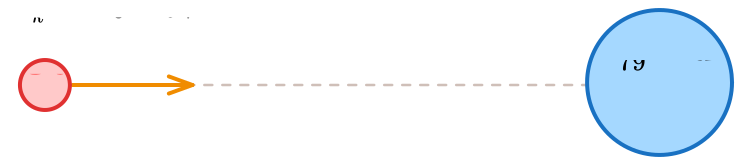
An -particle () is travelling in a vacuum directly towards the centre of a stationary gold nucleus (), as illustrated in the diagram below
The -particle is emitted from a source with an initial kinetic energy of 4.8 MeV. At a large distance from the gold nucleus, the -particle has its maximum speed. As it approaches the nucleus, it slows down until it comes to a momentary rest at a distance from the centre of the gold nucleus.
The -particle and the gold nucleus may be considered to be point charges that are isolated in space.
Calculate: (a) The initial kinetic energy of the alpha particle in Joules. (b) The distance .
(a) Finding the initial kinetic energy in joules
(b) Finding the distance of closest approach,
Tip: Mega Electron Volt ( ) to Joules ()
Summary Comparison: Potential vs Field
| Feature | Electric Field Strength () | Electric Potential () |
|---|---|---|
| Definition | Force per unit +ve charge | Work per unit +ve charge |
| Type | VECTOR (Magnitude & Direction) | SCALAR (Magnitude & Sign) |
| Formula (Point) | ||
| Relation | Gradient of Potential | Integral of Field |
| Inside Conductor | Zero | Constant (Non-zero) |
| Combined | Vector Addition | Algebraic Sum () |
The "Zero" Trap
Scenario: Two equal positive charges are separated by distance .
- Midpoint Field: (Vectors cancel: vs ).
- Midpoint Potential: . (Scalars add: ).
Scenario: One positive and one negative separated by .
- Midpoint Field: (Vectors add: and ).
- Midpoint Potential: (Scalars cancel: and ).