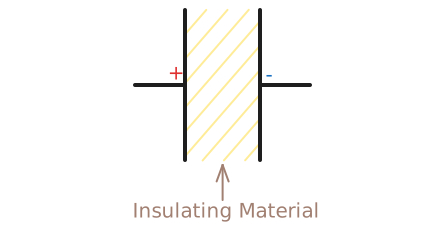
A capacitor is made using two parallel metal plates with an insulator in between.
When a potential difference is applied across the plates, the resulting electric field stores energy.
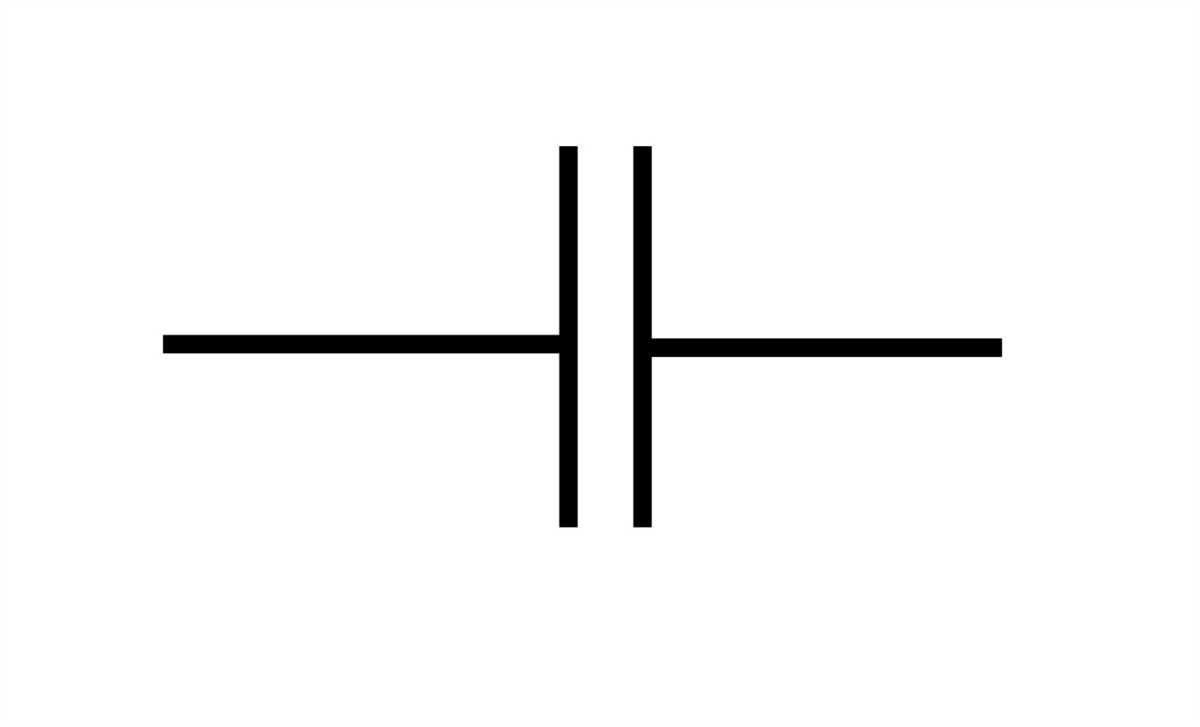
Electrical Symbol: Capacitor
Circuit symbol for a capacitor.
Definition of Capacitance
General Definition of Capacitance
Capacitance is the charge per unit potential difference.
C=VQ
Unit: Farad (F).
Nature:Scalar quantity
Tip: Sub-Farads
The Farad is very large, therefore for circuits, the micro-Farad (μF) or pico-Farad (pF) is used.
1F1F=106μF=1012pF
Context 1: Parallel Plate Capacitor
Definition: Capacitance of Parallel Plate Capacitor
The capacitance of a parallel plate capacitor is defined as the:
Ratio of the magnitude of charge on one of the plates
to the potential difference between the plates.
C=VQ
Where:
Q = The magnitude of charge on one plates.
V = The potential difference between the plates.
Net Charge: Parallel Plate Capacitors
The Net Charge is Zero.
Mechanism: When a capacitor is charged, the power supply moves electrons from one plate to the other.
Result: Plate A gains a charge of +Q, and Plate B gains an exactly equal and opposite charge of −Q.
Total Charge:Qnet=(+Q)+(−Q)=0.
Calculation Note: When using C=Q/V, always use the magnitude of charge on just one plate (Q), never the net charge (0) or the sum of magnitudes (2Q).
Context 2: Isolated Spherical Conductor
Definition: Capacitance of Isolated Charged Sphere
The capacitance of an isolated charged sphere is defined as the:
Ratio of the charge on the sphere to the electric potential at its surface.
C=VQ
Where:
Q = Total charge stored on the sphere.
V = Electric potential at the surface of the sphere (relative to zero potential at infinity).
Net Charge: Isolated Spheres
The Net Charge is NOT Zero.
Mechanism: An isolated sphere is charged by adding or removing electrons to/from the object itself (e.g., via friction or conduction).
Result: The sphere possesses a net excess of positive or negative charge.
Total Charge:Qnet=Q.
Calculation Note: When using C=Q/V, simply use the total excess charge Q residing on the surface of the sphere.
Capacitance of an Isolated Sphere
Derivation:
Recall the potential at the surface of a charged sphere of radius R:
V=4πϵ∘RQ
Recall the definition of capacitance:
C=VQ
Substitute V into the capacitance formula:
C=(4πϵ∘RQ)Q
Cancel Q and rearrange:
C=4πϵ∘R
Insight
Since 4πϵ∘ is constant,
C∝R
Combinations of Capacitors
A. Capacitors in Series
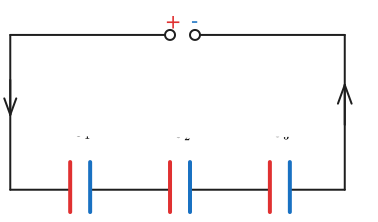
Capacitors in series.The Physics:
Charge: Due to electrostatic induction, the charge magnitude on each plate is the same.
If +Q flows to the left plate of C1, it repels +Q from the right plate.
This +Q flows to the left plate of C2 and so on.
∴Qtotal=Q1=Q2.
Potential Difference: The total potential difference is split across the components (Kirchhoff’s First Law).
Derivation:
Vtotal=V1+V2+…
Since V=CQ:
CtotalQ=C1Q+C2Q+…
Divide by Q:
Ctotal1=C11+C21+…
Examiner's Trap: The "Total Charge"
In a series circuit with two capacitors holding charge Q each:
Wrong: “Total charge is 2Q.”
Correct: “Charge stored by the combination is Q.”
Reason: The circuit externally only “sees” the +Q at the very start and the −Q at the very end. The internal charges cancel out.
Deep Dive: Electrostatic Induction
Many students memorize that “Charge is the same in series,” but few can explain why. The answer lies in Electrostatic Induction and Conservation of Charge.
The Setup
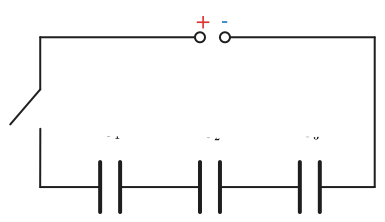
Imagine three capacitors C1,C2,C3 connected in series. Focus on the wire connecting the right plate of C1 to the left plate of C2.
This H-shaped section is an Electrically Isolated Island.
It is not connected to the battery. Charge cannot enter or leave this section; it can only redistribute.
The Process
Charging Plate 1: The battery pulls electrons off the left plate of C1, leaving it with a charge of +Q.
The Electric Field: This +Q creates an electric field across the gap of C1.
Induction on the “island”: The electric field attracts electrons from the “Isolated Island” towards the right plate of C1.
The right plate of C1 accumulates charge −Q.
Conservation of Charge: Since the “Island” started neutral (net charge of zero) and electrons (−Q) moved to the left side, the other side (the left plate of C2) is left with a deficiency of electrons.
Charge on left plate of C2=+Q.
The Result
This chain reaction forces every capacitor to have a charge separation of exactly +Q and −Q.
Qsource=QC1=QC2=QC3
NOTE: The battery only moved Q amount of charge at the terminals, the rest was just internal charge displacement.
B. Capacitors in Parallel
Circuit consisting of two capacitors in parallel.The Physics:
Potential Difference: Capacitors are connected in parallel, so potential difference is the same for all. (V=V1=V2).
Charge: The total current drawn from the source is divided among the branches (Kirchhoff’s First Law); Charge is also divided among the branches:
Capacitors in parallel behave like Resistors in Series. Adding more capacitors in parallel increases the total area available to store charge, thus increasing total capacitance.