Mechanism of Charging a Capacitor
Microscopic Analysis: Why is Work Done?
The battery acts as an electron pump that actively separates charge against an opposing Electric Field.
1. The Initial State ()
- The plates are neutral ().
- The first electron moved by the battery faces negligible repulsion from the destination plate.
- Virtually zero work is required to move the very first increment of charge.
2. The Intermediate State ()
- As electrons accumulate on the negative plate, they create a net negative charge.
- This charge creates an Electric Field between the plates that exerts a repulsive electrostatic force on any new incoming electrons.
- Simultaneously, the positive plate becomes more positive, attracting the electrons back (trying to prevent them from leaving).
- Crucial Physics: To move the next electron, the battery must exert a force to overcome this electrostatic repulsion/attraction.
- Work Done: Since , work is transferred from the chemical energy of the battery into the Electric Potential Energy of the charge configuration.
3. The Rising Difficulty (Why ?)
- As the charge on the plates increases, the Potential Difference increases ().
- Recall definition: .
- Therefore, the work required to deposit each subsequent unit of charge increases linearly.
- The last electron requires the most work; the first required none.
- This is why the total energy is the average of the work done: .
Graphical Determination ( Graph)
If we plot the Potential Difference () across a capacitor against the Charge stored ():
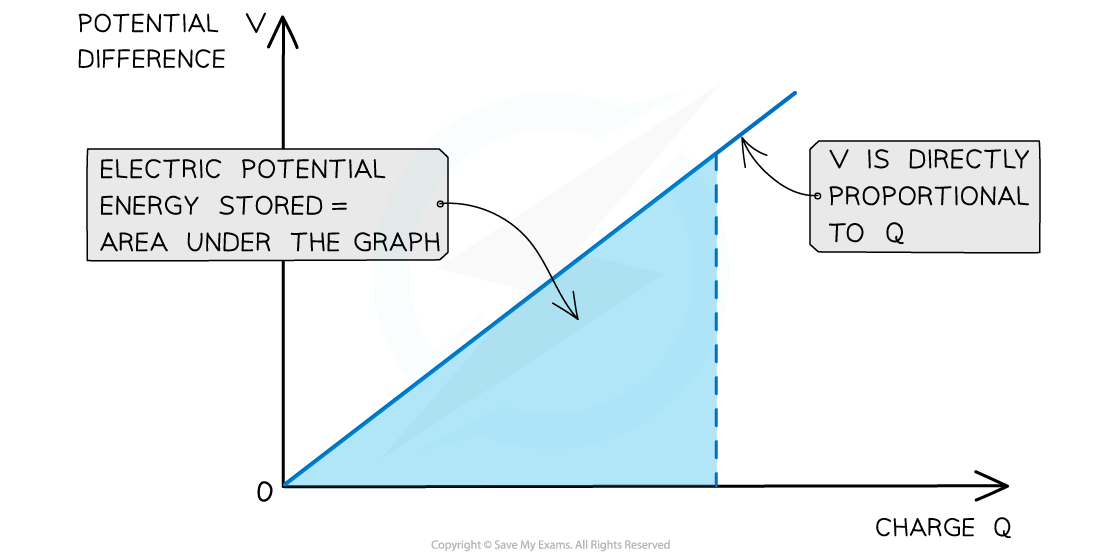
The V-Q Relationship
Since and is constant, the graph is a straight line through the origin.
- Gradient: (inverse of capacitance).
- Area Under Graph: Work Done / Energy Stored.
Why is it and not ?
- Common Mistake: Using .
- The Physics: applies when moving charge through a constant potential difference (like in a resistor).
- The Capacitor: When charging starts, . As charge builds up, increases linearly to its final value. The “average” potential difference during the process is only .
- Therefore, Energy = Area of Triangle = .
3. Energy Formulae
You must be able to recall the primary formula and derive the alternatives using .
Primary Formula (Area under graph)
- Use when: You know Charge and Voltage (rare in lab questions, common in theory).
Derived Formula 1 (The “Standard”)
Substitute :
- Use when: You know Capacitance and Voltage. This is the most common formula because is fixed and is easily measured with a voltmeter.
Derived Formula 2 (The “Isolated”)
Substitute :
- Use when: is constant (e.g., an isolated capacitor disconnected from the supply).
Dynamic Scenarios
Scenario A: Connected to Battery ( is constant)
Action: The plates are pulled further apart (distance increases).
- decreases (since ).
- is constant (fixed by battery).
- Formula Choice: Use .
- Result: Since drops, Energy Stored decreases.
- Where did the energy go? It flowed back into the battery.
Scenario B: Isolated / Disconnected ( is constant)
Action: The plates are pulled further apart (distance increases).
- decreases (since ).
- is constant (charge is trapped).
- Formula Choice: Use .
- Result: Since drops (and is in the denominator), Energy Stored increases.
- Where did the energy come from? Work was done by the external mechanical force pulling the attractive plates apart.
Energy in Combinations
Total Energy: Whether in Series or Parallel, the total energy stored is simply the sum of the individual energies.