22 Quantum physics
22.1 Energy and momentum of a photon
1. understand that electromagnetic radiation has a particulate nature
2. understand that a photon is a quantum of electromagnetic energy
- State what is meant by a photon
- A quantum of electromagnetic radiation
3. recall and use
N20 41 11
A photon of wavelength 540 nm collides with an isolated stationary electron. Explain why it is not possible for the deflected photon to have a wavelength of less than 540 nm.
- Smaller wavelength corresponds to a higher photon energy ().
- The photon loses energy in the collision therefore this is not possible.
Power and Photons
If power is kept constant, the number of photons per unit time is inversely proportional to . If you increase the energy of the photons (by increasing frequency), the number of photons decreases, and vice versa.
4. use the electronvolt (eV) as a unit of energy
5. understand that a photon has momentum and that the momentum is given by
S15 42 6
Explain why the magnitude of the final momentum of the electron is not equal to the change in magnitude of the momentum of the photon.
- Momentum is a vector quantity.
- Since the photon changes direction during the collision, momentum must be resolved in two dimensions rather than subtracting magnitudes.
W23 41 8
The beam of red light in (b) is now replaced with a beam of blue light of the same intensity. Suggest and explain whether the pressure exerted on the mirror by the beam of blue light is less than, the same as, or greater than the pressure exerted by the beam of red light.
- Blue light has a shorter wavelength than red light therefore the photons have greater momentum.
- However, since intensity and hence power is constant, number of photons per unit time will be smaller.
- Therefore pressure will be the same.
Determining force exerted by photons incident on a surface
A laser emits monochromatic red light. The light is produced when electrons move from a higher energy level to a lower energy level. The difference in energy between the two levels is . The power of the beam emitted by the laser is . The photons are incident normally on a surface. Half of the photons are absorbed by the surface, and half are reflected.
Determine the average force exerted by the beam of photons on the surface
- Number of photons incident on surface per unit time ()
- Initial momentum of photons ()
- Change of momentum of one absorbed photon
- Initial momentum ():
- Final momentum (): (They are absorbed)
- Change in momentum ():
- Change of momentum of one reflected photon (x2)
- Initial momentum ():
- Final momentum (): (Moves in opposite direction)
- Change in momentum ():
- Average change in momentum per incident photon
- Magnitude of average change in momentum per incident photon
- Average force
- Final calculation
22.2 Photoelectric effect
1. understand that photoelectrons may be emitted from a metal surface when it is illuminated by electromagnetic radiation
W25 44 9.a
State what is meant by the photoelectric effect The emission of electrons from a metal surface when electromagnetic radiation is incident on the surface.
2. understand and use the terms threshold frequency and threshold wavelength
M24 42 7
Explain the term threshold wavelength
- Maximum wavelength of electromagnetic radiation that causes electrons to be emitted from the surface of a metal.
W23 42 8
When the surface of a metal plate is illuminated with electromagnetic radiation, electrons are sometimes emitted from the metal. It is observed that this phenomenon occurs only when the frequency of the electromagnetic radiation is greater than a certain minimum value, regardless of the intensity of the radiation. Explain how this observation provides evidence for the existence of photons.
Electrons need a minimum energy to escape. Instead of accumulating energy continuously, an electron absorbs a single whole packet. A packet’s energy depends on frequency, not intensity. This explains why a minimum frequency is required. Intensity relates to the number of packets not to energy in a packet.
W21 42 9
A polished calcium plate in a vacuum is investigated by illuminating the surface with light. It is found that no photoelectric current is produced when the frequency of the light is less than . Explain how the photon model of electromagnetic radiation accounts for this phenomenon.
Electron needs a minimum energy to escape. Under the photon model, electromagnetic radiation consists of discrete packets. The energy of a packet is directly proportional to frequency of electromagnetic radiation. An electron absorbs a single whole packet.
3. explain photoelectric emission in terms of photon energy and work function energy
W22 41 8
Explain what is meant by work function of a metal
- Minimum photon energy to remove an electron from the surface.
W19 41 11
Explain why most electrons will have kinetic energy less than
- Some energy is required to bring electrons to the surface.
4. recall and use
S25 42 9
is the voltmeter reading at which the current just falls to zero. Explain with reference to photons, why depends on the frequency of the incident electromagnetic radiation.
- The current falls to zero when the potential difference equals the maximum kinetic energy per unit charge of the emitted electrons. ()
- The maximum kinetic energy of an emitted electron depends on the energy of the absorbed photon.
- The energy of an incident photon is directly proportional to frequency of the radiation ().
Explanation:
- In order for the current to be zero, no photoelectrons must be able to cross the gap between plate Y and plate X to complete the circuit.
- In order to ensure that no electrons reach plate X, all of them must be stopped, including the ones with maximum kinetic energy ().
- The electric field between the two plates does work against the motion of the electrons to stop them.
- To just stop all the electrons, the electric field must do work that is equal to .
- Since , , .
- Therefore, the stopping potential must be equal to the maximum kinetic energy per unit charge of the electron.
- Maximum kinetic energy depends on energy of absorbed photon.
- Energy of an absorbed photon is directly proportional to frequency of electromagnetic radiation.
- Therefore, depends on the frequency of incident electromagnetic radiation.
S22 41 7
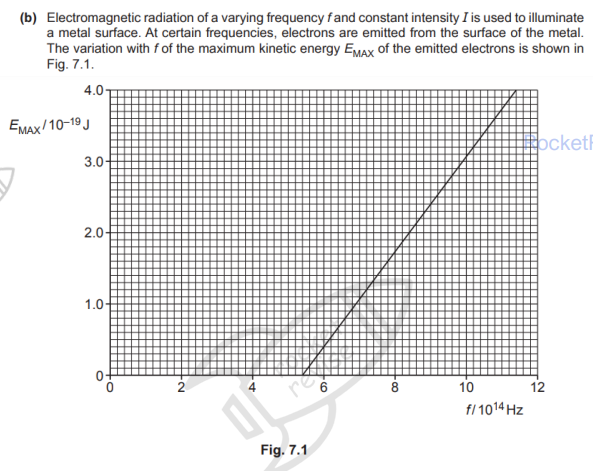
Conclusions that can be drawn from an against frequency graph:
- There is a threshold frequency below which no electrons are emitted. ()
- Work function of metal =
- Gradient of the line is the Planck constant (calculate and give value)
- increases linearly with increasing frequency
(Do not say both and as it may be treated as the same point in some mark schemes)
State with a reason, how the graph obtained would compare with Fig 7.1 when:
- A different metal is used, but keeping the intensity of the radiation the same
- Work function would be different.
- Graph would have the same gradient (since gradient = Planck constant) but would have different and intercepts. (-intercept = threshold frequency, -intercept = -work function).
- The same metal is used, but with electromagnetic radiation of intensity
- Energy of photons depends on frequency not intensity.
- Intensity simply relates to the number of photons.
- Graph would be unchanged.
5. explain why the maximum kinetic energy of photoelectrons is independent of intensity, whereas the photoelectric current is proportional to intensity
S21 41 12
Explain why the maximum kinetic energy of an emitted electron is independent of the intensity of the incident radiation
Maximum kinetic energy of a photoelectron depends on the energy of an absorbed photon. The energy of an individual photon is directly proportional to frequency of EM radiation but independent of intensity (). Intensity relates to the number of photons incident per unit time.
W22 41 8.c
The frequency of radiation incident on the surface of a metal is increased while the power remains constant. State and explain the effect of this change on:
- the maximum kinetic energy of photoelectrons
- Maximum kinetic energy increases.
- Photon energy increases and work function stays the same.
- the rate of emission of photoelectrons
- Since power remains constant and photon energy increases, there are fewer photons per unit time.
- Since each electron absorbs exactly one photon, fewer photons result in a lower rate of electron emission.
22.3 Wave-particle duality
1. understand that the photoelectric effect provides evidence for a particulate nature of electromagnetic radiation while phenomena such as interference and diffraction provide evidence for a wave nature
S22 42 8
State one piece of experimental evidence for:
- the particulate nature of electromagnetic radiation: photoelectric effect
- the wave nature of matter: electron diffraction
2. describe and interpret qualitatively the evidence provided by electron diffraction for the wave nature of particles
W24 42 9
Explain what this observation shows about the nature of electrons.
- Diffraction is characteristic of wave behaviour so the observation shows that electrons can behave like waves.
S25 44 9.a.i
An electromagnetic wave can behave like a particle. A moving particle can behave like a wave.
The following pattern is formed on the screen:
Explain why the pattern provides experimental evidence to indicate a wave nature of electrons.
- Concentric ring pattern with areas of constructive and destructive interference is similar to the diffraction pattern observed with light.
- Diffraction and interference are unique characteristics of wave behaviour.

3. understand the de Broglie wavelength as the wavelength associated with a moving particle
S25 41 8
State what is meant by the de Broglie wavelength
- Wavelength associated with a moving particle
S22 42 8
Suggest an explanation for why people are not observed to diffract when they walk through a doorway.
- The de Broglie wavelength of a walking person is negligible (much less) compared to the the width of a doorway.
Explanation: Diffraction only occurs if the wavelength is of a similar order of magnitude to, or larger than the width of the gap.
- if , diffraction occurs
- if , the wave passes through with negligible spreading
de Broglie wavelength of a person: For the average walking person:
- Typical width of a doorway is . Since , no diffraction occurs.
4. recall and use
S25 44 9.a.i (continued)
The speed of the electrons is increased. Suggest, with a reason how this change affects the pattern observed on the screen.
- de Broglie wavelength decreases ().
- rings become closer together ().
22.4 Energy levels in atoms and line spectra
1. understand that there are discrete electron energy levels in isolated atoms (e.g. atomic hydrogen)
W25 42 8.a
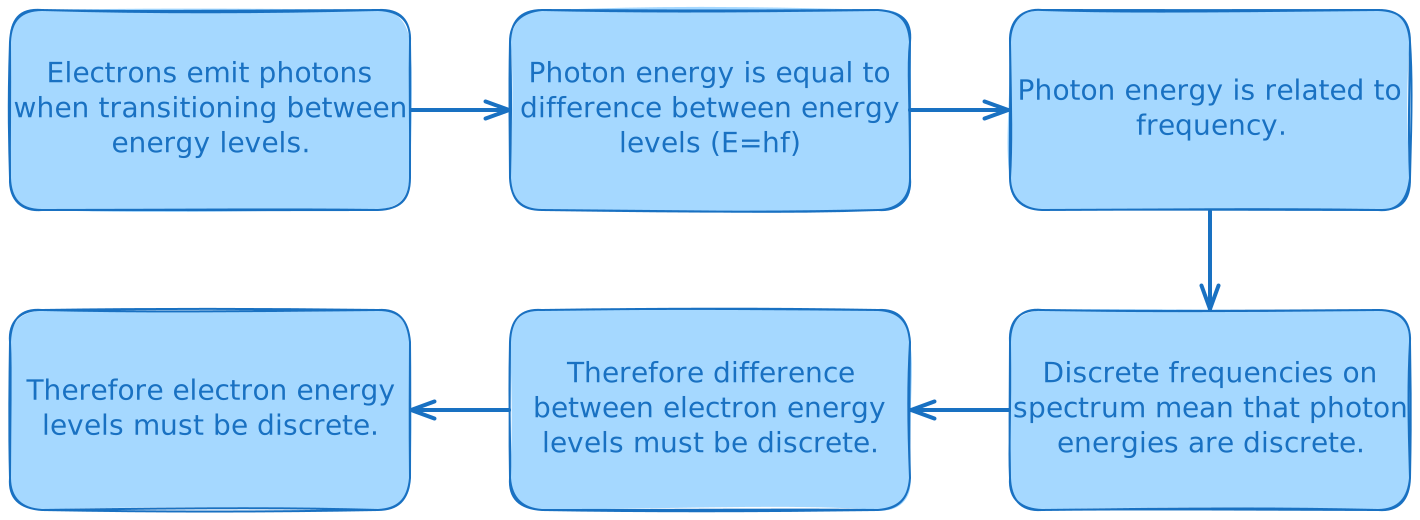
Use the photon model of electromagnetic radiation to explain how the existence of spectral lines in the emission spectrum provides evidence for discrete electron energy levels in the hydrogen atom.
Electrons transitioning between energy levels emit a single photon with energy equal to the difference between the energy levels. Since photon energy depends on frequency, discrete frequencies in the spectrum mean photon energies are discrete. Therefore the difference between electron energy levels, and the energy levels themselves, must be discrete. (50 words)
2. understand the appearance and formation of emission and absorption line spectra
M23 42 7
A beam of white light passes through a cloud of cool hydrogen gas. the spectrum of the transmitted light is viewed and contains a number of dark lines. explain why these dark lines occur.
- A single photon is absorbed by an electron in the gas and the electron is excited.
- An electron will only absorb a photon if the photon energy is equal to the difference between two energy levels.
- Because photon energy corresponds to a specific wavelength, only discrete wavelengths are absorbed.
- The excited electron de-excites and emits a photon in a random direction.
- This scatters specific wavelengths away from the transmitted beam, making them appear as dark lines.
3. recall and use
S23 42 8
Explain, with reference to photons, why there is a single frequency of electromagnetic radiation that corresponds to each of these transitions
- Transition of an electron to a lower energy level emits a single photon with energy equal to the difference between the two energy levels.
- Frequency of radiation corresponds to the photon energy.
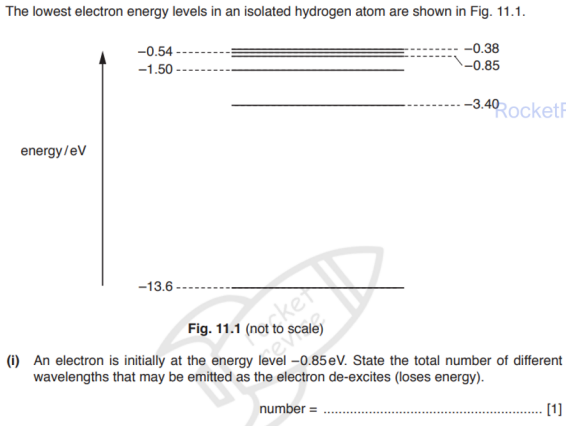
W18 42 11
Number of Wavelengths emitted:
Where is the number of levels including the starting level. In this case , therefore