22.1 Energy and momentum of a photon
22.2 Photoelectric effect
(W21 42 9)
A polished calcium plate in a vacuum is investigate by illuminating the surface with light. It is found that no photoelectric current is produced when the frequency of the light is less than . Explain how the photon model of electromagnetic radiation accounts for this phenomenon.
Electron needs a minimum energy to escape. Under the photon model, electromagnetic radiation consists of discrete packets. The energy of a packet is directly proportional to frequency of electromagnetic radiation. An electron absorbs a single whole packet.
(S21 41 12)
Explain why the maximum kinetic energy of an emitted electron is independent of the intensity of the incident radiation
Maximum kinetic energy of a photoelectron depends on the energy of an absorbed photon. The energy of an individual photon is directly proportional to frequency of EM radiation but independent of intensity (E=hf). Intensity relates to the number of photons incident per unit time.
(W22 41 8.c)
The frequency of radiation incident on the surface of a metal is increased while the power remains constant. State and explain the effect of this change on:
- the maximum kinetic energy of photoelectrons
- Maximum kinetic energy increases.
- Photon energy increases and work function stays the same.
- the rate of emission of photoelectrons
- Since power remains constant and photon energy increases, there are fewer photons per unit time.
- Since each electron absorbs exactly one photon, fewer photons result in lower rate of electron emission.
Tip
(S25 42 9)
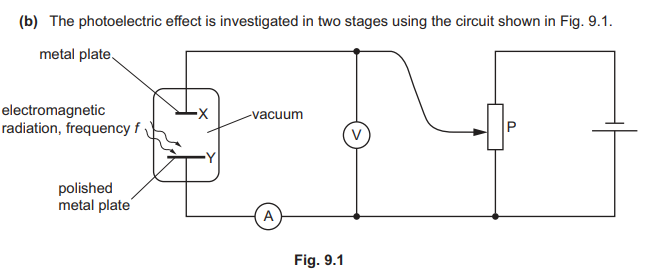 is the voltmeter reading at which the current just falls to zero.
Explain with reference to photons, why depends on the frequency of the incident electromagnetic radiation.
is the voltmeter reading at which the current just falls to zero.
Explain with reference to photons, why depends on the frequency of the incident electromagnetic radiation.
- The current falls to zero when the potential difference equals the maximum kinetic energy per unit charge of the emitted electrons. ()
- The maximum kinetic energy of an emitted electron depends on the energy of the absorbed photon.
- The energy of an incident photon is directly proportional to frequency of the radiation ()
explanation:
- In order for the current to be zero, no photoelectrons must be able to cross the gap between plate Y and plate X to complete the circuit.
- In order to ensure that no electrons reach plate X, all of them must be stopped, including the ones with maximum kinetic energy ().
- The electric field between the two plates does work against the motion of the electrons to stop them.
- To just stop all the electrons, the electric field must do work that is equal to .
- Since , ,
- Therefore, the stopping potential must be equal to the maximum kinetic energy per unit charge of the electron.
- Maximum kinetic energy depends on energy of absorbed photon.
- Energy of an absorbed photon is directly proportional to frequency of electromagnetic radiation.
- Therefore, depends on the frequency of incident electromagnetic radiation.
(S22 41 7)
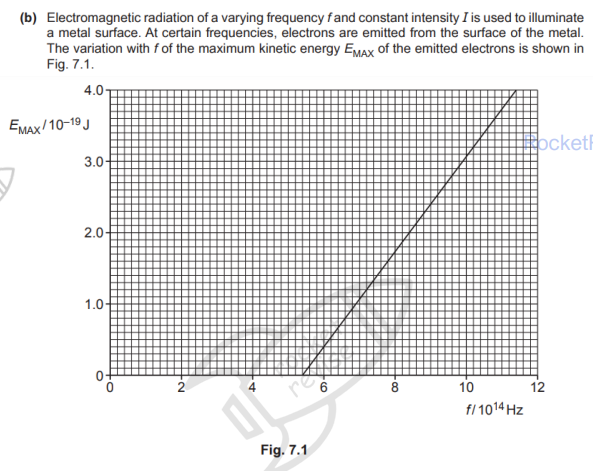
Conclusions that can be drawn from an against frequency graph:
- There is a threshold frequency below which no electrons are emitted. ()
- Work function of metal =
- Gradient of the line is the Planck constant (calculate and give value)
- increases linearly with increasing frequency
Do not say both and as it may be treated as the same point in some mark schemes
State with a reason, how the graph obtained would compare with Fig 7.1 when:
- A different metal is used, but keeping the intensity of the radiation the same
- Work function would be different
- Graph would have the same gradient (since gradient = Planck constant) but would have different and intercepts. (x-intercept=threshold frequency, y-intercept=-work function)
- The same metal is used, but with electromagnetic radiation of intensity
- Energy of photons depends on frequency not intensity
- Intensity simply relates to the number of photons
- Graph would be unchanged.
(W19 41 11)
Explain why most electrons will have kinetic energy less than Some energy is required to bring electrons to the surface
22.3 Wave-particle duality
(S22 42 8)
State one piece of experimental evidence for:
- the particulate nature of electromagnetic radiation: photoelectric effect
- the wave nature of matter: electron diffraction
Suggest an explanation for why people are not observed to diffract when they walk through a doorway.
- The de Broglie wavelength of a walking person is negligible compared to the the width of a doorway.
Explanation: diffraction only occurs if the wavelength is of a similar order of magnitude to, or larger than the width of the gap.
- if , diffraction occurs
- if , the wave passes through with negligible spreading
de Broglie wavelength of a person.
For the average walking person:
Typical width of a doorway is Since , no diffraction occurs
(S25 41 8)
State what is meant by the de Broglie wavelength
- Wavelength associated with a moving particle
(W24 42 9)
 Explain what this observation shows about the nature of electrons.
- Diffraction is characteristic of wave behaviour so the observation shows that electrons can behave like waves.
(S25 44 9.a.i)
An electromagnetic wave can behave like a particle a moving particle can behave like a wave
de broglie wavelength = h/p h: planck constant
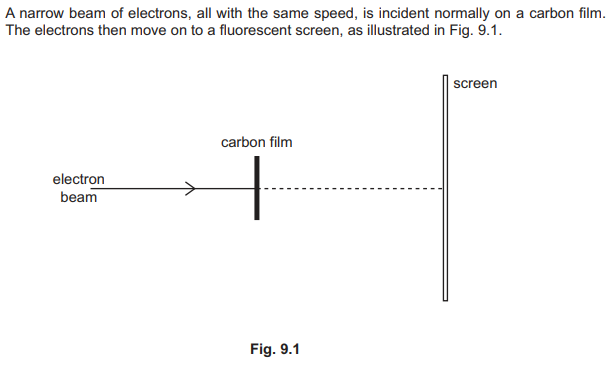 The following pattern is formed on the screen:

Explain why the pattern provides experimental evidence to indicate a wave nature of electrons.
- Concentric ring pattern with areas of constructive and destructive interference is similar to the diffraction pattern observed with light.
- Diffraction and interference are unique characteristics of wave behaviour.
The speed of the electrons is increased. Suggest, with a reason how this change affects the pattern observed on the screen.
- de Broglie wavelength decreases ().
- rings become closer together ()
22.4 Energy levels in atoms and line spectra
(W25 42 8.a)
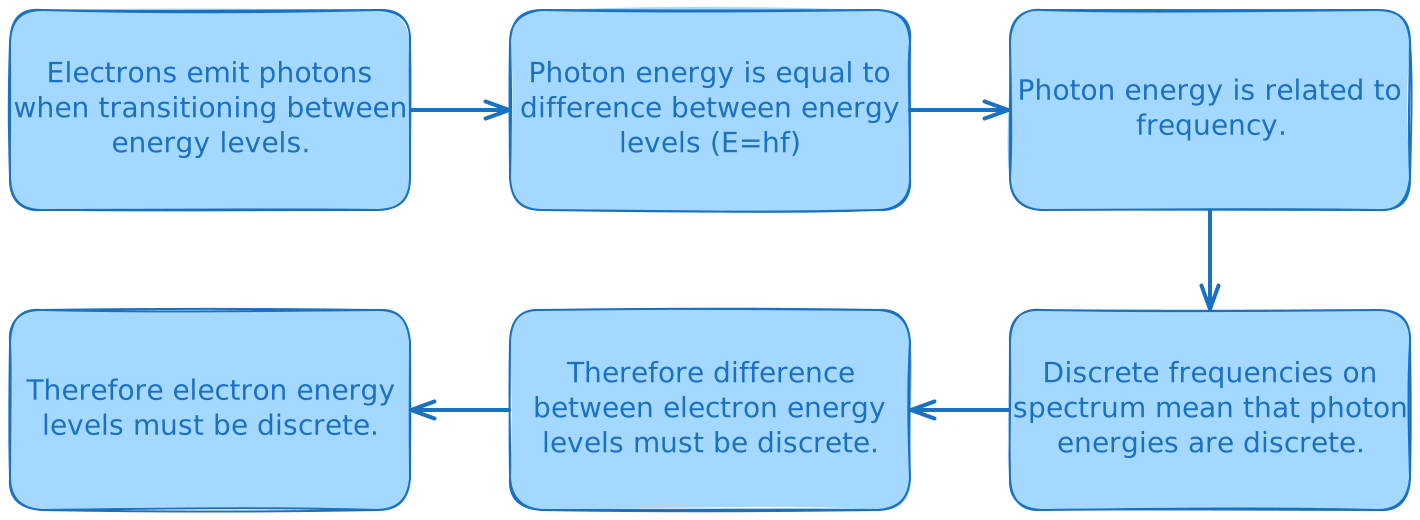
Use the photon model of electromagnetic radiation to explain how the existence of spectral lines in the emission spectrum provides evidence for discrete electron energy levels in the hydrogen atom.
Electrons transitioning between energy levels emit a single photon with energy equal to the difference between the energy levels. Since photon energy depends on frequency, discrete frequencies in the spectrum mean photon energies are discrete. Therefore the difference between electron energy levels, and the energy levels themselves, must be discrete. (50 words)
(M23 42 7)
A beam of white light passes through a cloud of cool hydrogen gas. the spectrum of the transmitted light is viewed and contains a number of dark lines. explain why these dark lines occur.
- A single photon is absorbed by an electron in the gas and the electron is excited.
- An electron will only absorb a photon if the photon energy is equal to the difference between two energy levels.
- Because photon energy corresponds to a specific wavelength, only discrete wavelengths are absorbed.
- The excited electron de-excites and emits a photon in a random direction.
- This scatters specific wavelengths away from the transmitted beam, making them appear as dark lines.
(S23 42 8)
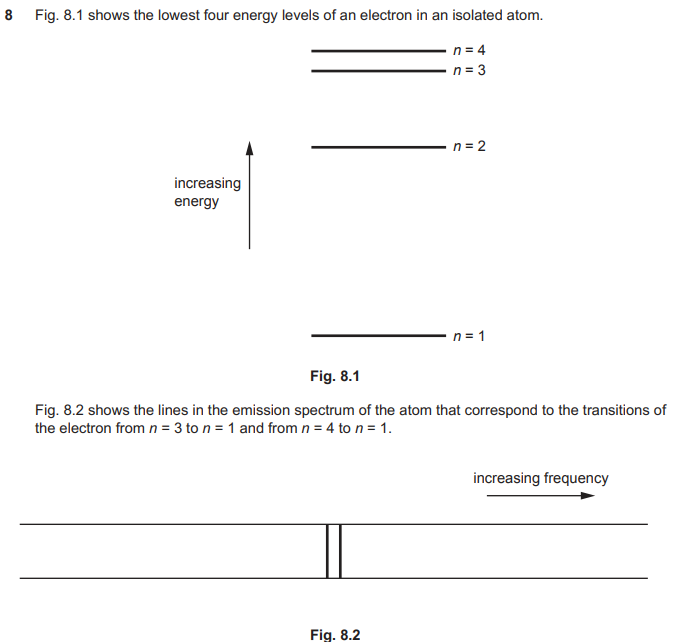 Explain, with reference to photons, why there is a single frequency of electromagnetic radiation that corresponds to each of these transitions
- transition of an electron to a lower energy level emits a single photon with energy equal tot he difference between the two energy levels.
- Frequency of radiation corresponds to the photon energy.
(W18 42 11)
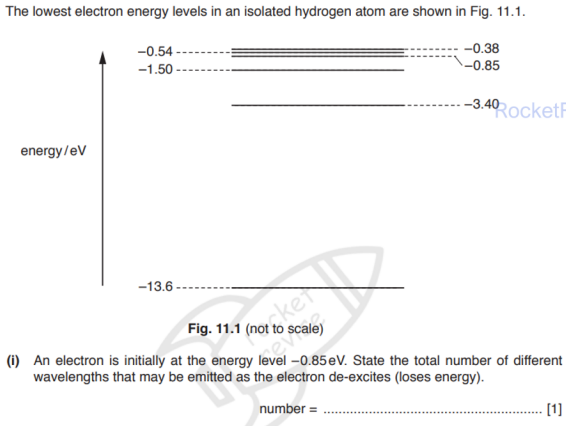
Where is the number of levels including the starting level. In this case , therefore
catching points:
change in momentum when reflects (x2)
changing frequency or something but keeping power/intensity constant
power = number of photons per unit time x hf if power const num photons inversely propto hf if you increase energy, num decreases and vice versa.
when justifying why negligible say much less