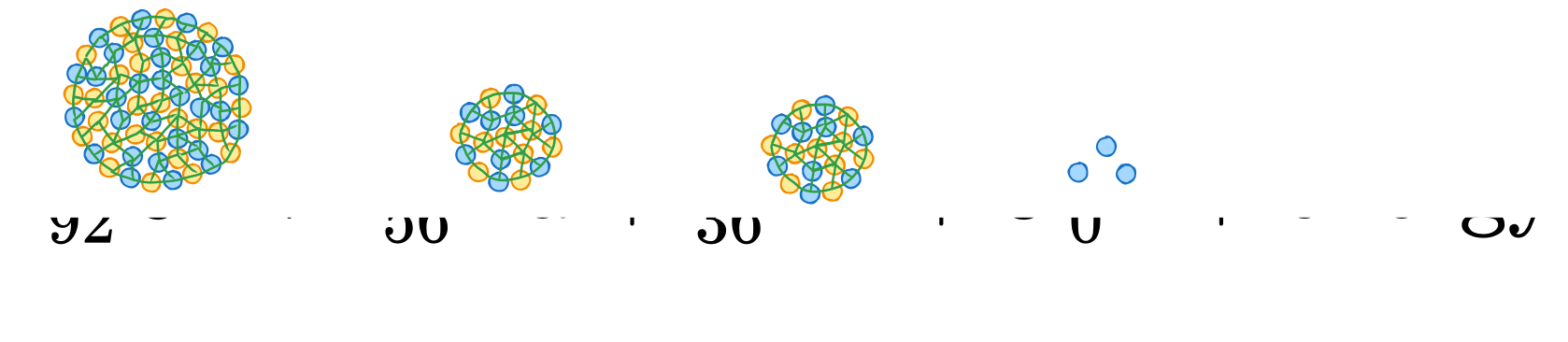
In 1905, Albert Einstein published his research showing that matter can be considered a form of energy. He proposed that mass and energy are entirely interchangeable.
Mass can be converted into energy (e.g., nuclear fusion in the sun, nuclear power plants, particle accelerators).
Energy can be converted into mass.
According to Einstein, since the decay of any radioactive nucleus releases energy, the total mass before the decay MUST exceed the total mass after the decay. The difference in mass before and after the decay is entirely equivalent to the total kinetic and electromagnetic energy of the decay products.
Mass-Energy Equivalence Equation
ΔE=Δmc2
Where:
E = Energy (J)
m = Mass (kg)
c = Speed of light (3.00×10⁸ m s−1)
Atomic Mass Unit Conversion:
Atomic, nuclear, and particle masses are usually expressed in unified atomic mass units (u).
1 u=1.6605×10⁻²⁷ kg
The energy equivalent of 1 u is exactly 931 MeV. This enables a direct conversion from mass in u to energy in MeV without needing to use E=mc2 in kg and Joules first.
Mass Defect
Definition: Mass Defect
The difference between the mass of a nucleus and the total mass of its constituent nucleons when they are infinitely separated
Calculating Mass Defect
Δm=Zmp+(A−Z)mn−mtotal
Where:
Z = proton number
A = nucleon number
mp = mass of a proton
mn = mass of a neutron
mtotal = measured mass of the intact nucleus
Nuclear Binding Energy
But why is Infinitely Separated Nucleons > Mass of Nucleus
Mass of nucleus compared to mass of infinitely separated nucleons
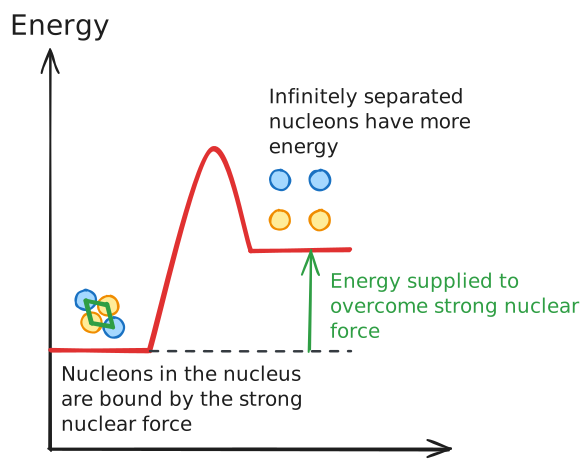
In the nucleus, the nucleons are held together by the strong nuclear force.
In order to infinitely separate the nucleons, energy must be supplied to the system to overcome the strong nuclear force.
This supplied energy is known as the Nuclear Binding Energy.
Since energy is supplied to the system, the total energy of the separated nucleons will be larger than the total energy of the nucleons when they are in the nucleus.
Since ΔE=Δmc2, the infinitely separated nucleons must have a larger total mass than the nucleus.
Energy change when nucleons are separated to infinity
Definition: Nuclear Binding Energy
The minimum energy required to separate all nucleons in a nucleus to infinity.
Binding Energy per Nucleon
Binding Energy per Nucleon
Binding Energy Per Nucleon=Number of NucleonsBinding Energy
Meaning of Binding Energy Per Nucleon
A higher binding energy per nucleon indicates a higher stability (more energy is required to separate the nucleons).
Binding Energy per Nucleon Graph
Graph of binding energy per nucleon against nucleon number showing the peak at Iron-56
Key features of the graph:
1. Low Values of A
Light nuclei have lower binding energies per nucleus.
They have weaker electrostatic forces and will undergo nuclear fusion to become more stable.
Helium-4 (24He), Carbon-12 (612C), and Oxygen-16 (816O) are anomalies; they do not fit the smooth trend and have exceptionally high BE/nucleon for their size.
2. Peak at A ≈ 56
Iron-56 has the highest binding energy per nucleon (≈8.8 MeV) making it the most stable of all elements.
3. High Values of A
The heaviest elements unstable and will undergo nuclear fission.
This instability is the result of electrostatic repulsion between protons starting to challenge the strong nuclear force.
4. Average Binding Energy per Nucleus
The average binding energy per nucleus is approximately 8 MeV.
Examiner Advice for Graph Sketching
If asked to sketch the Binding Energy per Nucleon graph:
Start the curve at A = 1 (do not start at A = 0, as A=0 is not a nucleus!).
Draw a steep initial positive gradient on the left.
Create a rounded peak around A = 56 (Iron).
Draw a shallower, continually decreasing negative gradient for higher A values.
The line must not drop back down to 0 binding energy.
Nuclear Fusion
Definition: Nuclear Fusion
Two small nuclei join together to form one large nucleus.
Total binding energy increases.
Example Nuclear Fusion Reaction
12H+12H→23He+01n+energy
The Mechanics of Nuclear Fusion
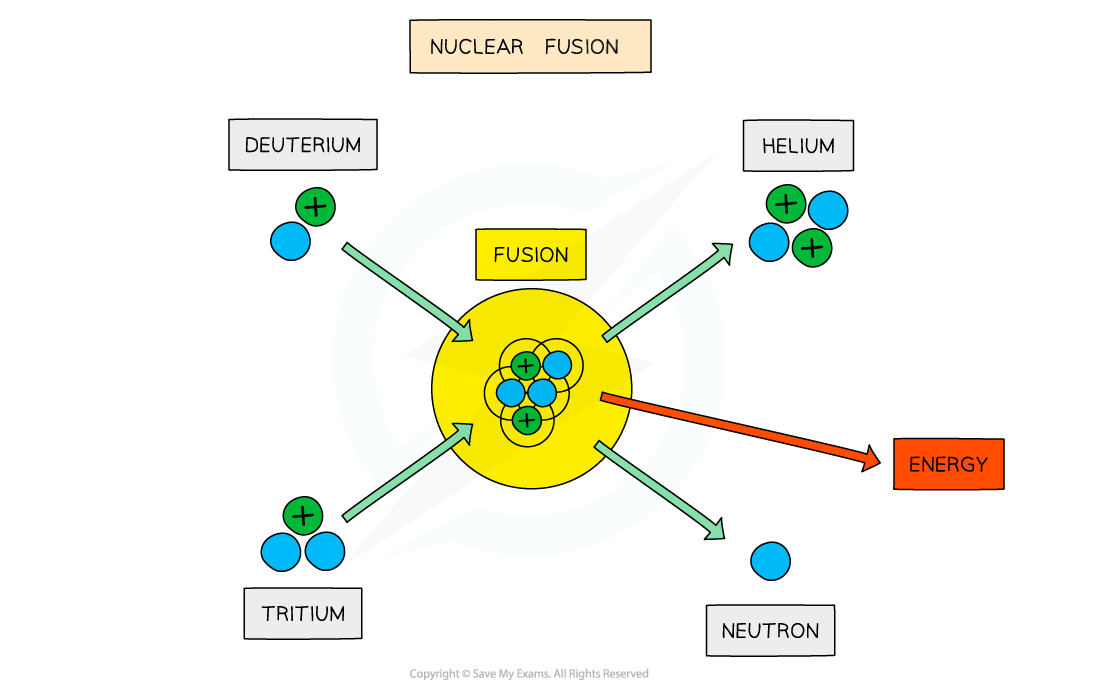
Fusion requires extremely high temperatures (like the core of a star) because both nuclei are positively charge and electrostatically repel each other strongly.
High kinetic energy is needed to force the nuclei close enough together (within 10−15 m) so that the short-range attractive strong nuclear force can overcome the electrostatic repulsion and bind them.
Diagram showing deuterium and tritium fusing to form helium, releasing a neutron and energy
Why Total Binding Energy Increases
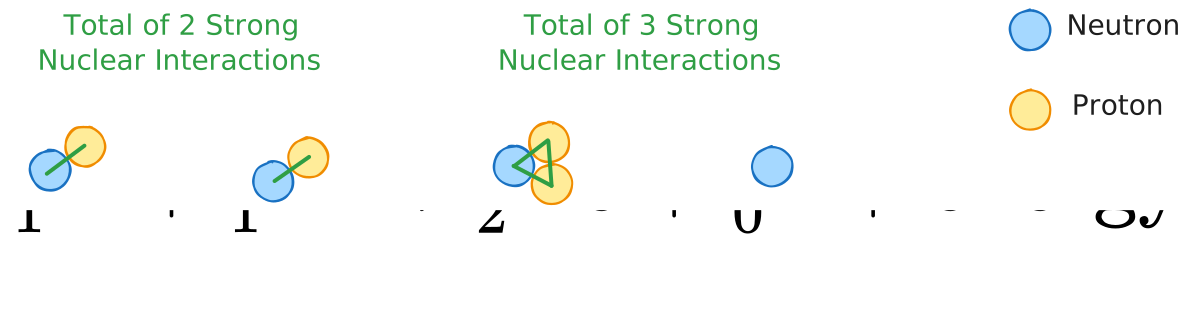
Increase in strong nuclear force interactions during Deuterium-Deuterium fusion
Fundamental Strengths
The strong nuclear force is the strongest of the four fundamental interactions.
It is roughly 100 times stronger than the electrostatic repulsion between protons at subatomic distances.
Range Limitation
Unlike electromagnetism which has an infinite range, the strong nuclear force has an extremely short range (≈1−2 fm).
It effectively acts only between immediate neighbours in the nucleus.
Nuclear Coordination in Fusion
When small nuclei fuse into a larger nucleus, each nucleon is surrounded by more direct neighbours.
More Attractive Bonds
The total number of strong nuclear interactions increases.
The Iron-56 Peak
Up to Iron-56, the increase in strong nuclear interactions is larger than the increase in electrostatic repulsion between protons.
Resulting Binding Energy
More energy is needed to separate the nucleons to infinity, therefore binding energy increases.
Nuclear Fission
Definition: Nuclear Fission
A single large nucleus divides to form smaller nuclei
Total binding energy increases
Example Nuclear Fission Reaction
092236U→056141Ba+3692Kr+301n+energy
The Mechanics of Nuclear Fission
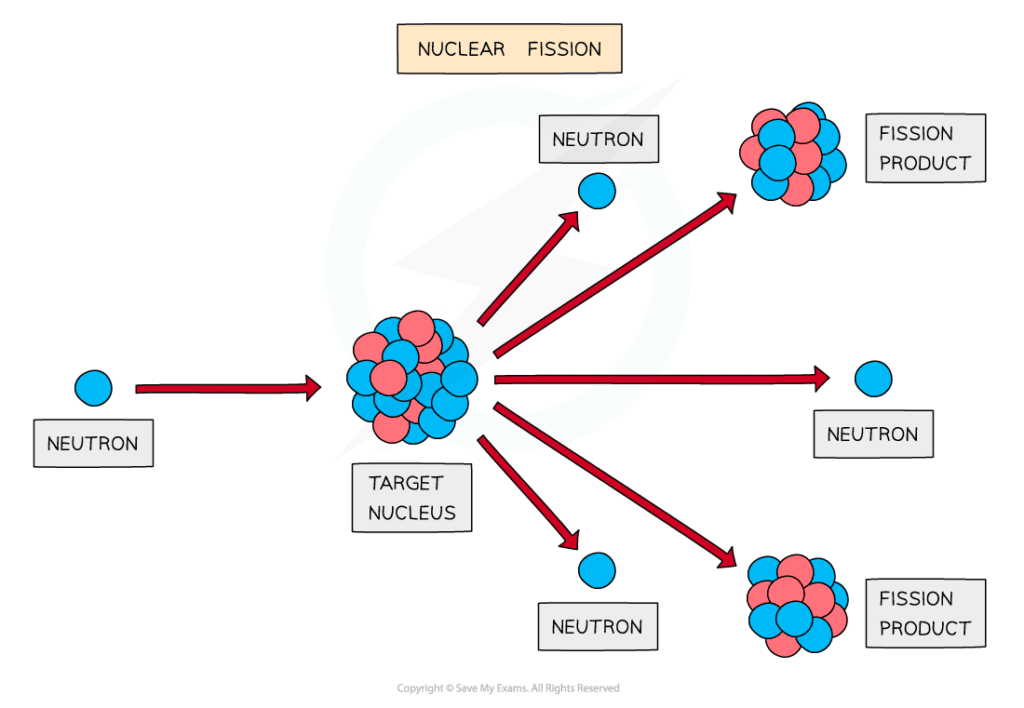
Usually initiated by neutron bombardment.
An unstable heavy nucleus absorbs a slow-moving neutron, becomes highly unstable, and splits into fission fragments (daughter nuclei).
Energy and more neutrons are releases (which can trigger a chain reaction)
Diagram showing a neutron striking a target nucleus causing it to split into two fission products and three neutrons
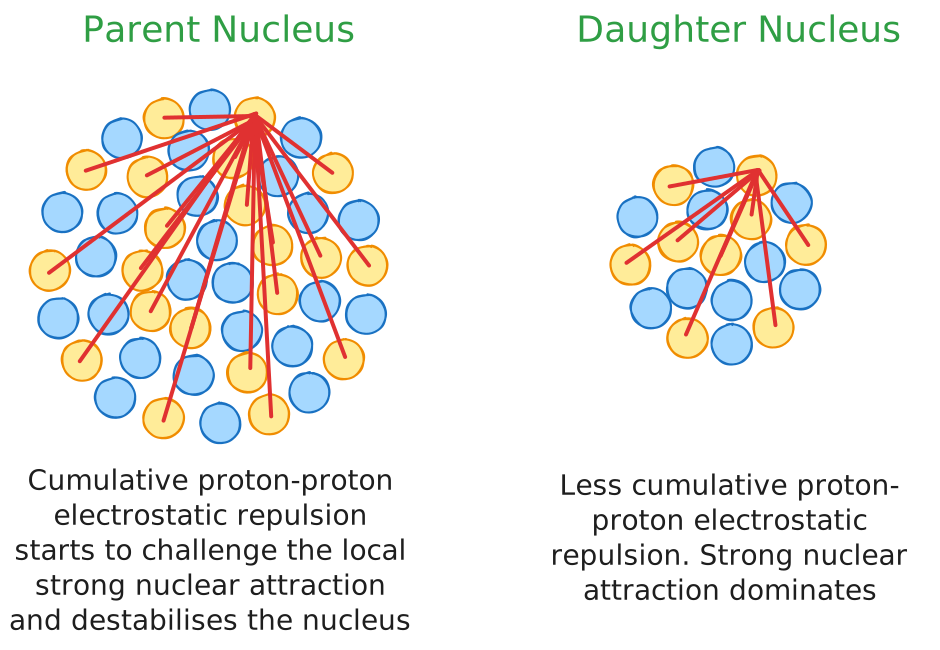
Why Total Binding Energy Increases
Splitting of a large nucleus during nuclear fission
Cumulative repulsion from protons in large vs small nuclei
Saturation of the Strong Nuclear Force
A proton only feels attraction from its 3 or 4 immediate neighbours.
The attractive strong force per nucleon is roughly the same in both large and small nuclei.
Long Range Electrostatic Repulsion
Electromagnetism has an infinite range.
In the smaller nucleus, there are fewer total protons.
Proton-Proton repulsion is less in smaller nuclei.
Effect on Binding Energy
In smaller nuclei, there is less repulsion fighting against the strong force.
Binding energy per nucleon increases (since they are held more tightly together)
Total binding energy increases.
Energy Released during Nuclear Reactions
Calculating Energy Released
The energy released in a nuclear reaction can be calculated using the mass-energy equivalence formula:
E=c2Δm
Steps for calculation:
Calculate the total mass of reactants.
Calculate the total mass of products.
Find the mass difference (Δm=massreactants−massproducts).
Convert Δm from unified atomic mass units (u) into kg (multiply by 1.66×10⁻²⁷).
Multiply by c2 to find Energy in Joules.
(Alternatively, multiply mass difference in ‘u’ directly by 931 to get energy in MeV).