Syllabus 23.1 Mass defect and nuclear binding energy
Candidates should be able to:
understand the equivalence between energy and mass as represented by E=mc2 and recall and use this equation
represent simple nuclear reactions by nuclear equations of the form 714N+24He→817O+11H
define and use the terms mass defect and binding energy
sketch the variation of binding energy per nucleon with nucleon number
explain what is meant by nuclear fusion and nuclear fission
explain the relevance of binding energy per nucleon to nuclear reactions, including nuclear fusion and nuclear fission
calculate the energy released in nuclear reactions using E=c2Δm
23.1 Mass Defect and Nuclear Binding Energy
Equivalence of Mass and Energy
In 1905, Albert Einstein published his research showing that matter can be considered a form of energy. He proposed that mass and energy are entirely interchangeable.
Mass can be converted into energy (e.g., nuclear fusion in the sun, nuclear power plants, particle accelerators).
Energy can be converted into mass.
According to Einstein, since the decay of any radioactive nucleus releases energy, the total mass before the decay MUST exceed the total mass after the decay. The difference in mass before and after the decay is entirely equivalent to the total kinetic and electromagnetic energy of the decay products.
Mass-Energy Equivalence Equation
E=mc2
Where:
E = Energy (J)
m = Mass (kg)
c = Speed of light (3.00×10⁸ m s−1)
Atomic Mass Unit Conversion:
Atomic, nuclear, and particle masses are usually expressed in unified atomic mass units (u).
1 u=1.6605×10⁻²⁷ kg
The energy equivalent of 1 u is exactly 931 MeV. This enables a direct conversion from mass in u to energy in MeV without needing to use E=mc2 in kg and Joules first.
Representing Simple Nuclear Reactions
A nucleus can be described using standard notation ZAX.
Nucleon Number (A): The total number of protons and neutrons in the nucleus (top number).
Proton Number (Z): The total number of protons in the nucleus (bottom number).
When writing nuclear equations, the total nucleon number (A) and total proton number (Z) must be conserved on both sides of the equation.
AZX Notation representing the nucleon and proton number of a chemical symbol
Definition: Mass Defect
The difference between the mass of a nucleus and the total mass of its constituent nucleons when they are infinitely separated.
Source: 9702_w25_qp_42 - Mark Scheme
Common Pitfall
The definition of mass defect is frequently misunderstood. Do not define it as a “change in mass during a nuclear reaction”, nor describe it as an “energy”. It is strictly the difference in mass between the intact nucleus and its infinitely separated nucleons. (Source: Examiner Report 9702_w25_qp_42)
Calculating Mass Defect
Δm=Zmp+(A−Z)mn−mtotal
Where:
Z = proton number
A = nucleon number
mp = mass of a proton
mn = mass of a neutron
mtotal = measured mass of the intact nucleus
9702_w25_qp_42_qu_009 (a)
Question:
State what is meant by the mass defect of a nucleus.
Mark Scheme:
difference between mass of nucleus and mass of (constituent) nucleons (1)
when nucleons are separated to infinity (1)
Examiner Report:
The definition of mass defect seems to be less well known than other definitions. Some candidates appeared to have the right idea but did not use the terminology correctly (particularly with nucleus/nuclei/nuclide/nucleons/neutrons). Many of the candidates that did identify mass defect as the difference in mass between the nucleus and its constituent nucleons did not make the point that the latter mass is when the nucleons are infinitely separated.
9702_s23_qp_42_qu_009 (a)
Question:
Define mass defect.
Mark Scheme:
difference between mass of nucleus and (total) mass of nucleons (1)
when infinitely separated (1)
Examiner Report:
Many candidates did not give a correct answer. Many candidates tried to suggest that it is an energy, and others described it as a change in mass during a nuclear process. Correct use of technical terms is important, and many responses conflated nucleus, nucleons and neutrons by using them as synonymous terms.
Nuclear Binding Energy
A system of separated nucleons has a greater mass than a system of bound nucleons. Because nuclei are made up of neutrons and protons, there are forces of electrostatic repulsion between the positive protons. Therefore, it takes energy to hold nucleons together as a nucleus.
Energy and mass are proportional, so the total energy of a nucleus is less than the sum of the energies of its constituent nucleons. The formation of a nucleus from isolated nucleons is an exothermic reaction (it releases energy).
Definition: Nuclear Binding Energy
The (minimum) energy required to separate all the nucleons in a nucleus to infinity.
Source: 9702_s24_qp_42 - Mark Scheme
Critical Information
Avoid describing binding energy as the “energy stored in the nucleus”. This is incorrect physics. It is the energy that must be put into the nucleus to separate all the nucleons against the strong nuclear force.
9702_s24_qp_42_qu_009 (a)
Question:
State what is meant by the binding energy of a nucleus.
Mark Scheme:
energy required to separate (all) the nucleons (in the nucleus) (1)
to infinity (1)
Examiner Report:
The definition of binding energy was not well known by the weaker candidates. Nucleus, nuclei, nucleons and neutrons were often confused, and the direction of the energy transfer was sometimes the wrong way around. Some candidates gave contradictory definitions and therefore could not be awarded credit.
9702_m24_qp_42_qu_008 (a)
Question:
State what is meant by the binding energy of a nucleus.
Mark Scheme:
(minimum) energy required to separate the nucleons (of a nucleus) (1)
to infinity (1)
Binding Energy per Nucleon
In order to compare nuclear stability between different elements, it is more useful to look at the binding energy per nucleon.
Binding energy per nucleon = Total Binding Energy / Nucleon Number (A).
A higher binding energy per nucleon indicates a higher stability (more energy is required to separate the nucleons).
Graph of binding energy per nucleon against nucleon number showing the peak at Iron-56
Key features of the graph:
Low values of A: Light nuclei have lower binding energies per nucleon. They have weaker electrostatic forces and will undergo fusion to become more stable. The gradient is very steep. Helium-4 (24He), Carbon-12 (612C), and Oxygen-16 (816O) are anomalies; they do not fit the smooth trend and have exceptionally high BE/nucleon for their size.
Peak at A ≈ 56: Iron-56 has the highest binding energy per nucleon (approx 8.8 MeV), making it the most stable of all elements.
High values of A: The heaviest elements are unstable and will undergo fission. The gradient is much less steep here. Fission reactions release less binding energy per nucleon than fusion reactions.
Examiner Advice for Graph Sketching
If asked to sketch the Binding Energy per Nucleon graph:
Start the curve at A = 1 (do not start at A = 0, as A=0 is not a nucleus!).
Draw a steep initial positive gradient on the left.
Create a rounded peak around A = 56 (Iron).
Draw a shallower, continually decreasing negative gradient for higher A values.
The line must not drop back down to 0 binding energy.
9702_s24_qp_42_qu_009 (c)
Question:
(i) On Fig. 9.1, sketch the variation with nucleon number A of binding energy per nucleon for values of A from 1 to 250.
(ii) On your line in Fig. 9.1, draw an X to show the approximate position of polonium-212.
(iii) Polonium-212 is radioactive and undergoes alpha-decay. Suggest and explain, with reference to Fig. 9.1, why the alpha-decay of polonium-212 results in a release of energy.
Mark Scheme:
(i)
line rising to a single peak that is to the left of the ‘9’ in the Fig. 9.1 label and then continually decreasing (1)
steep positive gradient on the left of the peak and shallow negative gradient on the right (1)
(ii)
X shown on the line at a value of A that is to the right of the left-hand edge of the ‘A’ in the axis label, and to the left of ‘2’ in the 250 label (1)
(iii)
nucleus formed (as a result of the decay) has a lower nucleon number (1)
(nucleus formed has a) greater binding energy per nucleon (1)
Examiner Report:
(i) Most candidates knew the general shape of the curve, but it was common for the peak to be too far to the right or for the line to the right of the peak to descend too steeply.
(ii) Candidates needed to judge how far along the axis 212 is compared with 250. It was common for X to be too far to the left or not on the line.
(iii) Many candidates did not heed the instruction to refer to Fig 9.1. Candidates were expected to explain that the nucleus formed has a lower nucleon number, and as a result it has a greater binding energy per nucleon.
9702_w23_qp_41_qu_009 (b)(c)
Question:
(b) On Fig. 9.1, sketch the variation of binding energy per nucleon with nucleon number A for values of A between 1 and 250.
(c) On your line in Fig. 9.1, label:
(i) a point X that could represent a nucleus that undergoes alpha-decay.
(ii) a point Y that could represent a nucleus that undergoes nuclear fusion.
Mark Scheme:
(b)
line with a peak at A ≈ 56 (1)
line with steep initial positive gradient on the left of peak and shallower negative gradient at all points to the right of peak and line does not return to 0 binding energy (1)
(c)
(i) X shown at value of A to the right of the peak (1)
(ii) Y shown at value of A close to 1 (1)
Definition: Nuclear Fusion & Fission
Nuclear Fusion: Two (small) nuclei join together to form one larger nucleus. (Source: 9702_w23_qp_41)
Nuclear Fission: A single large nucleus splits/divides to form two (or more) smaller nuclei. (Source: Synthesized from SME/Collins & MS 9702_w24_qp_42)
Nuclear Fission and Fusion Explained
Nuclear Fusion:
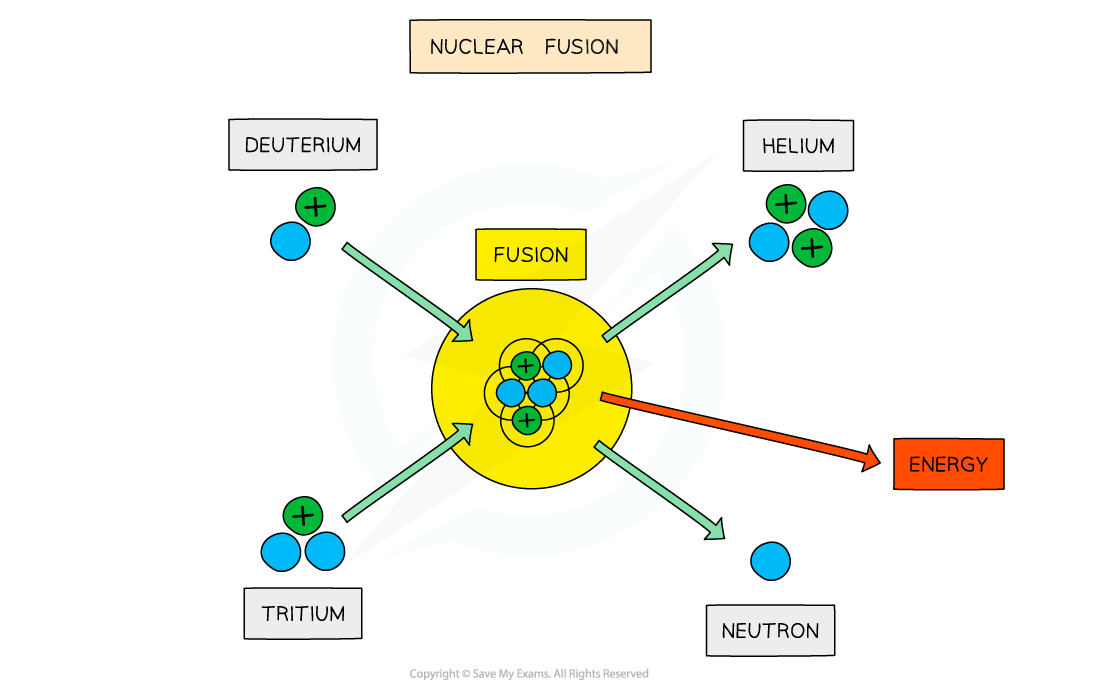
Fusion requires extremely high temperatures (like the core of a star) because both nuclei are positively charged. They electrostatically repel each other strongly. High kinetic energy is needed to force the nuclei close enough together (to within 10−15 m) so that the short-range attractive strong nuclear force can overcome the electrostatic repulsion and bind them.
Diagram showing deuterium and tritium fusing to form helium, releasing a neutron and energy
Nuclear Fission:
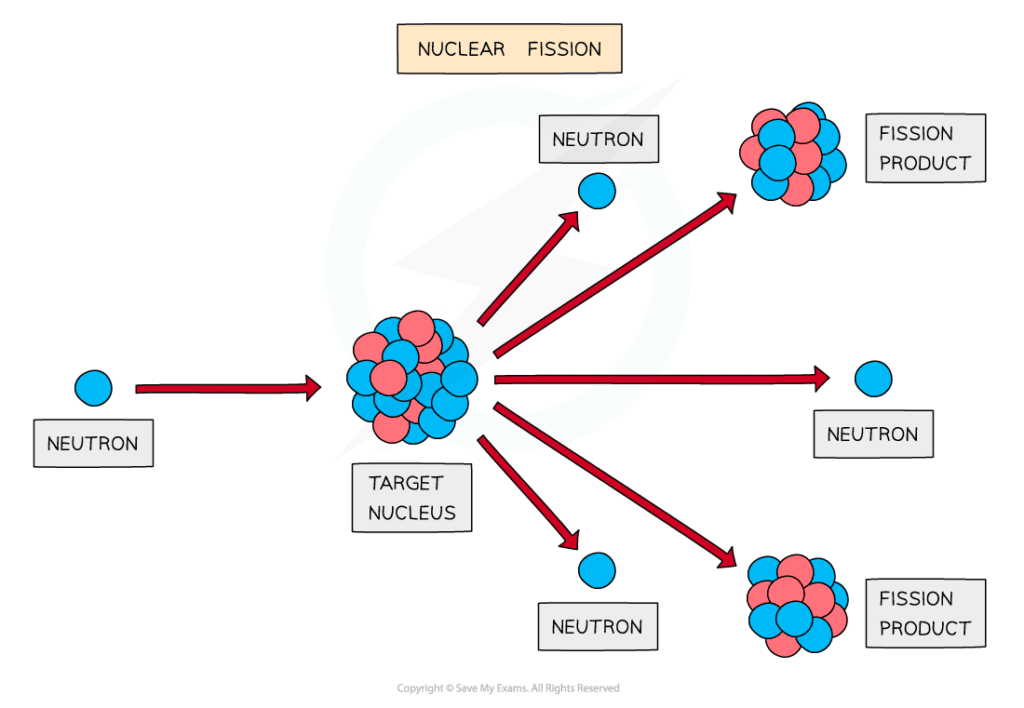
Usually initiated by neutron bombardment. An unstable heavy nucleus absorbs a slow-moving neutron, becomes highly unstable, and splits into fission fragments (daughter nuclei), releasing energy and more neutrons (which can trigger a cascade/chain reaction).
Diagram showing a neutron striking a target nucleus causing it to split into two fission products and three neutrons
Why both release energy:
In both processes, the products formed have a higher binding energy per nucleon than the reactants. This means the products are more tightly bound and stable. Consequently, the total mass of the products is strictly less than the total mass of the reactants. This mass defect is converted entirely into energy (E=mc2), appearing primarily as the kinetic energy of the products/fragments and gamma radiation.
9702_w24_qp_42_qu_010 (b)
Question:
(i) Describe the differences between nuclear fission and nuclear fusion.
(ii) Explain, with reference to the variation of binding energy per nucleon with nucleon number, why the processes of nuclear fission and nuclear fusion both result in a release of energy.
Mark Scheme:
(i) Any three points, 1 mark each:
large nuclei undergo fission whereas small nuclei undergo fusion
fission involves one nucleus splitting into two (or more) (smaller) nuclei
fusion involves two nuclei joining together to form one (larger) nucleus
fission is (usually) initiated by neutron bombardment
fusion is (usually) initiated by (very) high temperatures
(ii)
binding energy per nucleon is greatest for intermediate nucleon numbers (1)
both fusion and fission involve an increase in binding energy (per nucleon) (1)
Examiner Report:
(i) Candidates needed to be very clear when referring to a single nucleus vs multiple nuclei. Many failed to explain that fission involves a single nucleus splitting, instead describing processes akin to radioactive decay. Explanations of fusion often relied on the word ‘fuse’, so candidates needed to make clear that this involves two nuclei joining together.
(ii) Many responses did not answer the question asked, discussing mass defect instead of the variation of BE per nucleon with nucleon number.
9702_w23_qp_41_qu_009 (a)
Question:
State what is meant by nuclear fusion.
Mark Scheme:
(two small) nuclei join together (1)
to form one larger nucleus (1)
Calculating Energy Released
The energy released in a nuclear reaction can be calculated using the mass-energy equivalence formula:
E=c2Δm
Steps for calculation:
Calculate the total mass of reactants.
Calculate the total mass of products.
Find the mass difference (Δm=massreactants−massproducts).
Convert Δm from unified atomic mass units (u) into kg (multiply by 1.66×10⁻²⁷).
Multiply by c2 to find Energy in Joules.
(Alternatively, multiply mass difference in ‘u’ directly by 931 to get energy in MeV).
9702_w25_qp_42_qu_009 (b)
Question:
The nuclear fusion reaction for the formation of helium-4 from deuterium is represented by:
12H+12H→24He
Table 9.1 shows the masses of the nuclides involved:
12H: 2.013553 u
24He: 4.001505 u
Calculate the energy released in the formation of 1.00 mol of helium-4.
Mark Scheme:
Δm=(2×2.013553)−4.001505=0.025601 u (C1)
E=c2Δm (C1)
Energy from one He-4 nucleus =0.025601×1.66×10−27×(3.00×108)2=3.82×10⁻¹² J (C1)
Energy to form 1.00 mol =3.82×10−12×6.02×1023=2.30×10¹² J (A1)
Examiner Report:
Many of the more able candidates obtained credit for determining the energy release from the formation of one nucleus of helium, but then stopped short of extending that to one mole.
9702_s25_qp_44_qu_011
Question:
The deuterium nucleus (12H) has a mass defect of 0.002388 u. The helium-4 nucleus (24He) has a mass defect of 0.030377 u. Helium-4 is formed from deuterium in a nuclear reaction:
312H→24He+11p+01n
(a)(i) State the name of this type of nuclear reaction.
(a)(ii) Show that the energy released when one nucleus of helium-4 is formed from deuterium is 3.47×10⁻¹² J.
Examiner Report:
(a)(i) The correct spelling of the technical term ‘fusion’ was required to ensure there was no ambiguity with ‘fission’.
(a)(ii) Most candidates appreciated this was a ‘show that’ question, and laid out their derivation clearly. Occasionally the conversion of mass defect from u to kg was not shown.
9702_s24_qp_42_qu_009 (b)
Question:
Table 9.1 shows the masses of sub-atomic particles and a polonium-212 (84212Po) nucleus.
proton: 1.007276 u
neutron: 1.008665 u
polonium-212: 211.942749 u
For the polonium-212 nucleus, determine:
(i) the mass defect Δm in kg
(ii) the binding energy in J
(iii) the binding energy per nucleon in J.
Mark Scheme:
(i)
Δm=[(84×1.007276)+(128×1.008665)]−211.942749=1.778 u (C1)
=1.778×1.66×10−27 kg (C1)
=2.95×10⁻²⁷ kg (A1)
(ii)
E=Δmc2 (C1)
BE=2.95×10−27×(3.00×108)2=2.66×10⁻¹⁰ J (A1)
(iii)
BE per nucleon =2.66×10⁻¹⁰/212=1.25×10−12 J (A1)
Examiner Report:
(i) Many calculated the mass defect in u but stopped short of converting it to kg. Premature rounding or using the proton mass instead of the unified atomic mass unit caused errors.
(ii) A common mistake was to forget to square the speed of light.
(iii) A common mistake was to divide by either the proton number or neutron number instead of the nucleon number (212).
9702_m24_qp_42_qu_008 (b)
Question:
A nucleus of uranium-235 absorbs a neutron and undergoes fission:
92235U+01n→54142Xe+3890Sr+neutrons
(i) Determine the number of neutrons produced.
(ii) Data for BE per nucleon: U-235 (7.59 MeV), Xe-142 (8.37 MeV), Sr-90 (8.72 MeV). Calculate the energy released in MeV from the fission of one nucleus of U-235.
(iii) Suggest a reason why Xe-142 is unstable.
Mark Scheme:
(i) 4 (A1)
(ii)
Energy=(142×8.37)+(90×8.72)−(235×7.59) (C1)
=190 MeV (A1)
(iii) either it has too many neutrons (for the number of protons) OR its neutron to proton ratio is too high (B1)
9702_w25_qp_41_qu_008 (b)(c)
Question:
(b) A stationary nucleus of uranium-238 (92238U) undergoes alpha decay to produce thorium-234. The kinetic energy of the emitted alpha particle is 4.200 MeV. A gamma-ray photon is also emitted. The total energy released is 4.274 MeV.
Data: α (4.000407 u), Th-234 (233.915174 u).
(i) Calculate the mass, in u, of the U-238 nuclide to 5 decimal places.
(ii) Determine the wavelength of the gamma radiation emitted.
(iii) In practice, the rebound kinetic energy of the Th nucleus is not negligible. Explain how your answer in (ii) compares with the true wavelength.
(c) Co-60 decays by beta emission and emits gamma radiation. Suggest why there is not a single wavelength for the gamma radiation emitted.
Mark Scheme:
(b)(i)
E=c2Δm→Δm=(4.274×106×1.6×10−19)/(1.66×10−27×9×1016)=0.00458 u (C1, C1)
m=233.915174+4.000407+0.00458=237.92016 u (A1)
(b)(ii)
E=hc/λ (C1)
(4.274−4.200)×1.6×10−13=(6.63×10−34×3×108)/λ (C1)
λ=1.7×10⁻¹¹ m (A1)
(b)(iii) (true) energy of gamma photon is smaller so (true) wavelength is larger (B1)
(c)
(anti)neutrinos are emitted during beta decay (B1)
particles emitted during beta decay carry varying amounts of energy, so energy of gamma photon is also variable (between decays) (B1)
23.2 Radioactive Decay
Syllabus 23.2 Radioactive decay
Candidates should be able to:
understand that fluctuations in count rate provide evidence for the random nature of radioactive decay
understand that radioactive decay is both spontaneous and random
define activity and decay constant, and recall and use A=λN
define half-life
use λ=0.693/t1/2
understand the exponential nature of radioactive decay, and sketch and use the relationship x=x0e−λt, where x could represent activity, number of undecayed nuclei or received count rate
Random and Spontaneous Nature of Decay
Radioactive decay is the spontaneous disintegration of a nucleus to form a more stable nucleus, resulting in the emission of an alpha, beta, or gamma particle.
Random Nature:
Radioactive decay is random. A random process is one in which the exact time of decay of a specific nucleus cannot be predicted. Instead, every undecayed nucleus has a constant probability of decaying in a given time interval.
Evidence: When a Geiger-Muller (GM) tube is placed near a radioactive source, the count rate fluctuates irregularly.
Spontaneous Nature:
Radioactive decay is spontaneous. A spontaneous process is one which cannot be influenced by environmental factors such as temperature, pressure, or chemical conditions.
Definitions: Random and Spontaneous
Random: Cannot predict when a particular nucleus will decay OR cannot predict which nucleus will decay next.
Source: 9702_w24_qp_42 - Mark SchemeSpontaneous: (Decay is) not affected by external / environmental factors.
Source: 9702_s25_qp_42 - Mark Scheme
Examiner Advice
When defining “random”, weaker candidates mistakenly think everything about radioactive decay is unpredictable. This is false. Unpredictability is only at the level of the individual nuclei. On a macroscopic scale with a large number of nuclei, the decay rate is highly mathematically predictable! (Source: ER 9702_w24_qp_42)
9702_w24_qp_42_qu_010 (a)
Question:
Radioactive decay is both random and spontaneous. State what is meant by:
(i) random
(ii) spontaneous
(iii) State one piece of evidence for the random nature of decay.
Mark Scheme:
(i) cannot predict when a particular nucleus will decay OR cannot predict which nucleus will decay next (1)
(ii) (decay is) not affected by external (environmental) factors (1)
(iii) fluctuations in (measured) count rate (1)
Examiner Report:
The meaning of ‘spontaneous’ was generally better understood than ‘random’. Candidates must realise that the unpredictability is only on the level of individual nuclei.
9702_s23_qp_41_qu_009 (c)
Question:
(i) Explain, with reference to the random nature of radioactive decay, why the activity of a sample decreases with time.
(ii) State, with reasons, whether a radiation detector placed near to the sample indicates a measured count rate that is less than, the same as, or greater than the activity of the sample.
Mark Scheme:
(i)
every (undecayed) nucleus has the same probability of decay (1)
fewer (undecayed) nuclei remaining (with time), so fewer will decay (in a given time interval) (1)
(ii)
sample emits in all directions but detector only captures emissions in one direction / some emissions are absorbed before reaching detector / simultaneous arrival of multiple particles only registers once (2)
measured count rate is less than the activity (1)
Definition: Activity
The number of nuclear disintegrations per unit time.
Source: 9702_s25_qp_41 - Mark SchemeUnit: Becquerel (Bq). 1 Bq=1 decay per second.
Definition: Decay Constant ( λ)
The probability of decay of a nucleus per unit time.
Source: Synthesized from SME/Collins
Activity Equation
A=λN
Where:
A = Activity (Bq)
λ = Decay constant (s−1)
N = Number of undecayed nuclei in the sample
Definition: Half-life
The time for the activity (of a sample) to halve.
Source: 9702_s24_qp_41 - Mark Scheme
Common Pitfall
Do not define half-life as “the time for half the nuclei to decay.” If an isotope decays into another radioactive daughter isotope, the total number of radioactive nuclei might not halve. The safest and most rigorous definition accepted by examiners is “the time taken for the activity to halve.”
Half-life Equation
t1/2=λln2≈λ0.693
Where:
t1/2 = Half-life
λ = Decay constant
9702_s25_qp_41_qu_009 (a)
Question:
(a) Define activity of a radioactive sample.
(b) Explain why the variation with time of the activity of a radioactive sample is exponential in nature.
Mark Scheme:
(a) number of nuclear disintegrations per unit time (1)
(b)
activity is proportional to the number of undecayed nuclei (1)
activity = (–) rate of change of number of undecayed nuclei (1)
N is proportional to the rate of change of N (so exponential variation) (1)
Exponential Nature of Radioactive Decay
In radioactive decay, the number of undecayed nuclei N, the activity A, and the count rate C all decrease exponentially with time. This means they fall by a constant ratio in equal time intervals.
Exponential Decay Graph showing shallow and steep decay curves based on decay constant size
Decay Equations
N=N0e−λtA=A0e−λtC=C0e−λt
Taking the natural log (ln) of both sides yields a linear equation (e.g., lnA=lnA0−λt). A graph of lnA vs t produces a straight line where the magnitude of the gradient is the decay constant λ.
9702_m25_qp_42_qu_009 (d)
Question:
A pure sample of polonium-193 contains N0 nuclei. After time t it contains N nuclei. The variation of ln(N/N0) with t is a straight line graph with a negative gradient.
(i) State the name of the quantity that is represented by the magnitude of the gradient of the line.
(ii) The line passes through (0, 0) and (0.84 ms, -1.4). Use the graph to determine the half-life, in ms.
Mark Scheme:
(i) decay constant (1)
(ii)
decay constant = magnitude of gradient = 1.4/0.84 (C1)
half-life=ln2/(1.4/0.84)=0.42 ms (A1)
9702_w22_qp_41_qu_010 (b)
Question:
Fig. 10.1 shows the variation with t of the value of ln(M/10−16g) where M is the mass of Carbon-15. The plotted points scatter slightly around a linear trend.
(i) State how Fig. 10.1 demonstrates that radioactive decay is random.
(iii) Show that the decay constant λ is given by the magnitude of the gradient of your line of best fit.
Mark Scheme:
(i) line fluctuates OR trend is a straight line (1)
(iii)
M=M0e−λt
so lnM=lnM0−λt so gradient = −λ (and magnitude of gradient = λ) (1)
9702_s25_qp_42_qu_010 (b)
Question:
Two radioactive isotopes X and Y decay to stable isotopes. X has initial activity 4A and half-life 2T. Y has initial activity A and half-life 3T.
Determine, in terms of T, the time at which the two samples will have equal activities.
Mark Scheme:
correct substitution of A0 and λ into A0e−λt for sample X or Y (C1)
4Ae−tln2/2T=Ae−tln2/3T (C1)
t=12T (A1)
9702_m23_qp_42_qu_008 (b)
Question:
The power source in a space probe contains 0.874 kg of Plutonium-238. Each nucleus that decays emits 5.59 MeV. The half-life is 87.7 years.
(i) Calculate initial number N0 of Pu-238 nuclei.
(ii) Determine initial activity.
(iii) Determine initial power output.
(iv) Calculate the time, in years, until the power output decreases to 65.3% of its initial value.
Mark Scheme:
(i) N0=0.874/(238×1.66×10−27)=2.21×1024 (A1)
(ii) A=λN→[(ln2)/(87.7×365×24×3600)]×2.21×1024=5.54×1014 Bq (C1, A1)
(iii) Power=5.54×1014×5.59×106×1.60×10−19=496 W (C1, A1)
(iv)
65.3=100e−(ln2/87.7)t (C1)
ln(0.653)=−(ln2/87.7)t→t=53.9 years (A1)
Examiner Report:
(iv) Premature rounding of intermediate values leads to incorrect answers in the final significant figure, and this was a common problem in this question. The data justifies a 3 significant figure answer. Candidates who used a value of decay constant prematurely rounded to 3sf often arrived at an answer that was not quite correct.