A piezoelectric crystal is a crystalline solid such as quartz that deforms when a potential difference is applied across it.
Deformation of a quartz crystal when a p.d. is applied across it
Model Answer
Describe the function of a quartz crystal in medical imaging.
Acts as a transducer
To generate and detect ultrasound.
Applying a p.d. causes the crystal to vibrate
Vibrations cause crystal to generate an e.m.f.
Generation of Ultrasounds
Workings of a piezoelectric crystal
Setup
Piezoelectric crystal is connected to an A.C. power supply
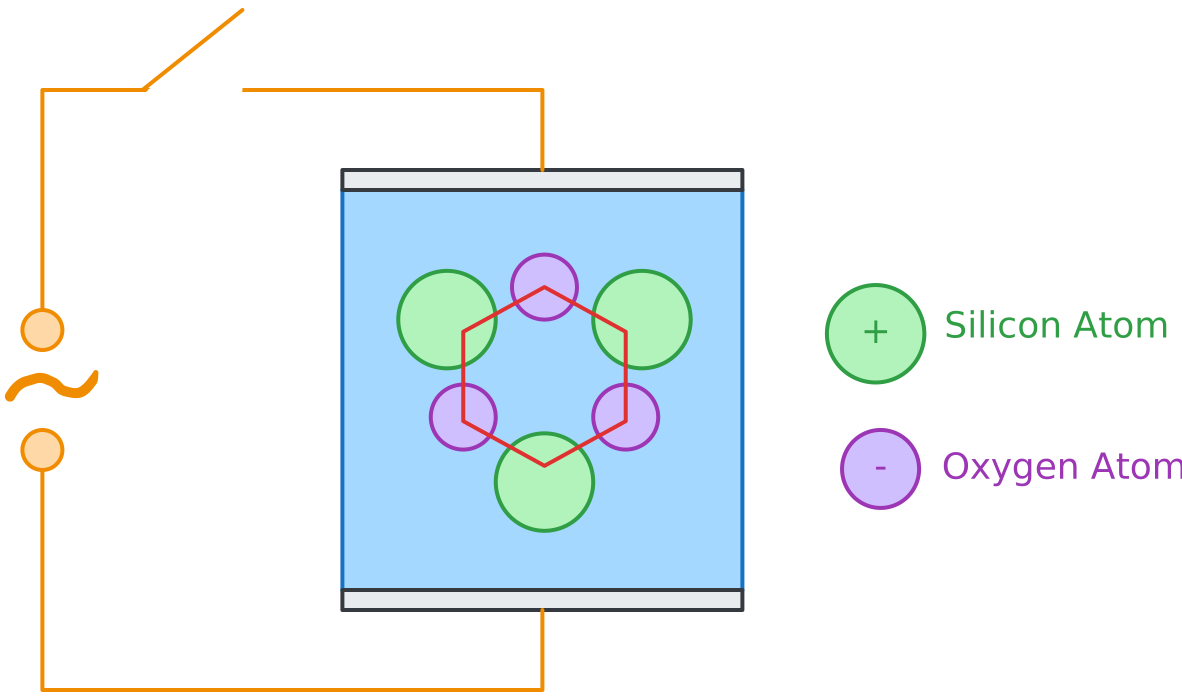
A piezoelectric crystal (quartz) consists of silicon and oxygen atoms arranged in a 3D tetrahedral structure.
Since oxygen is more electronegative than silicon, the oxygen atoms have a partial negative charge and the silicon atoms have a partial positive charge
Contraction
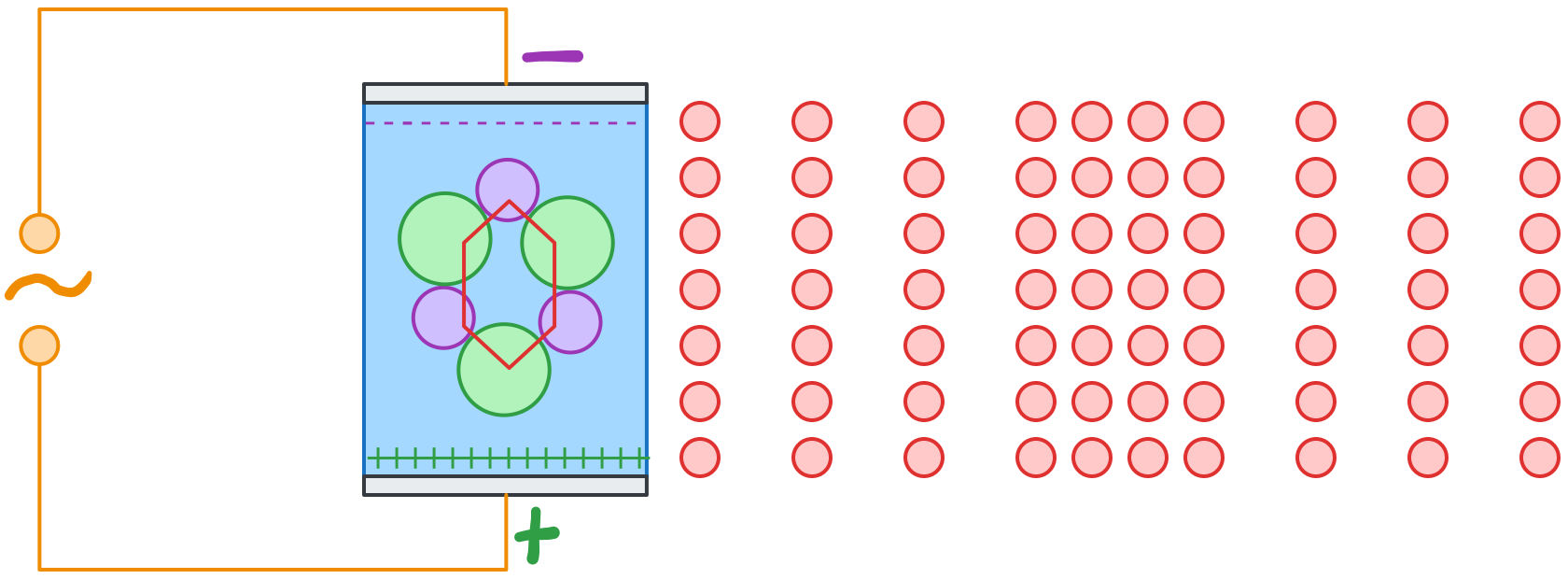
Piezoelectric crystal contractsWhen the top terminal is negative and the bottom terminal is positive
Like charges repel and unlike charges attract
The positive silicon atoms are attracted to the top plate
The negative oxygen atoms are attracted to the bottom plate
This causes the crystal structure to stretch, leading to it contracting horizontally
This creates a region of rarefaction in the sound wave
Expansion
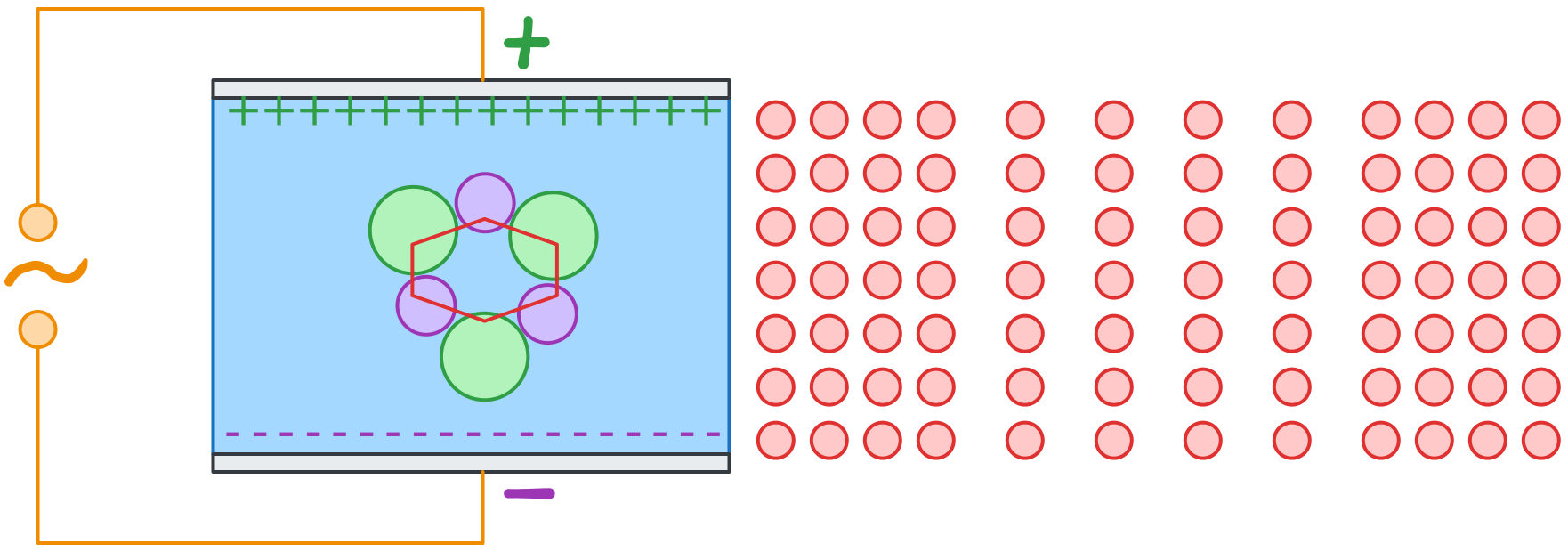
Piezoelectric crystal expandsWhen the top plate is positive and the bottom plate is negative
Like charges repel and unlike charges attract
The positive silicon atoms are repelled from the top plate
The negative oxygen atoms are repelled from the bottom plate
This causes the crystal structure to compress, leading to it expanding horizontally
This creates a region of compression in the sound wave
How is the ultrasound wave produced
The piezoelectric crystal expands and contracts at the frequency of the applied A.C.
When the frequency of the A.C. equals the natural frequency of the piezoelectric crystal, the crystal resonates.
The crystal is cut so that the natural frequency of the crystal is in the ultrasound wave
This leads to the generation of ultrasound waves from the compressions and rarefactions caused by the crystal.
Model Exam Answer
Explain the principles of the generation of ultrasound waves for use in medical diagnosis.
Applying an alternating p.d. to a quartz crystal causes it to vibrate.
When frequency of applied p.d. equals natural frequency of the crystal, the crystal resonates.
Natural frequency of the crystal is in the ultrasound range.
Additional Marks (more than 3 marks)
Applying a p.d. to a quartz crystal causes it to distort.
Crystal cut so that natural frequency is in ultrasound range.
Model Exam Answer
A sinusoidal alternating voltage has a root-mean-square (r.m.s.) potential difference (p.d.) of 4.2 V and a frequency of 50 kHz. The alternating voltage is applied to a piezoelectric crystal in air. Explain what happens to the air surrounding the crystal
Alternating p.d. causes the crystal to vibrate.
Vibration of crystal causes air to vibrate.
Frequency is in ultrasound range.
>20 kHz), but if you are given the frequency always crosscheck.
Usually frequency will be in ultrasound range (
Detection of Ultrasound
Model Exam Answer
Explain how ultrasound waves are detected in medical diagnosis.
Reflected pulses of ultrasound are incident on a quartz crystal
Ultrasound waves cause quartz crystal to vibrate.
Vibrations of crystal cause induced e.m.f. across the crystal.