X-rays are electromagnetic waves which have wavelengths in the range 10−8 to 10−13m
Producing X-rays
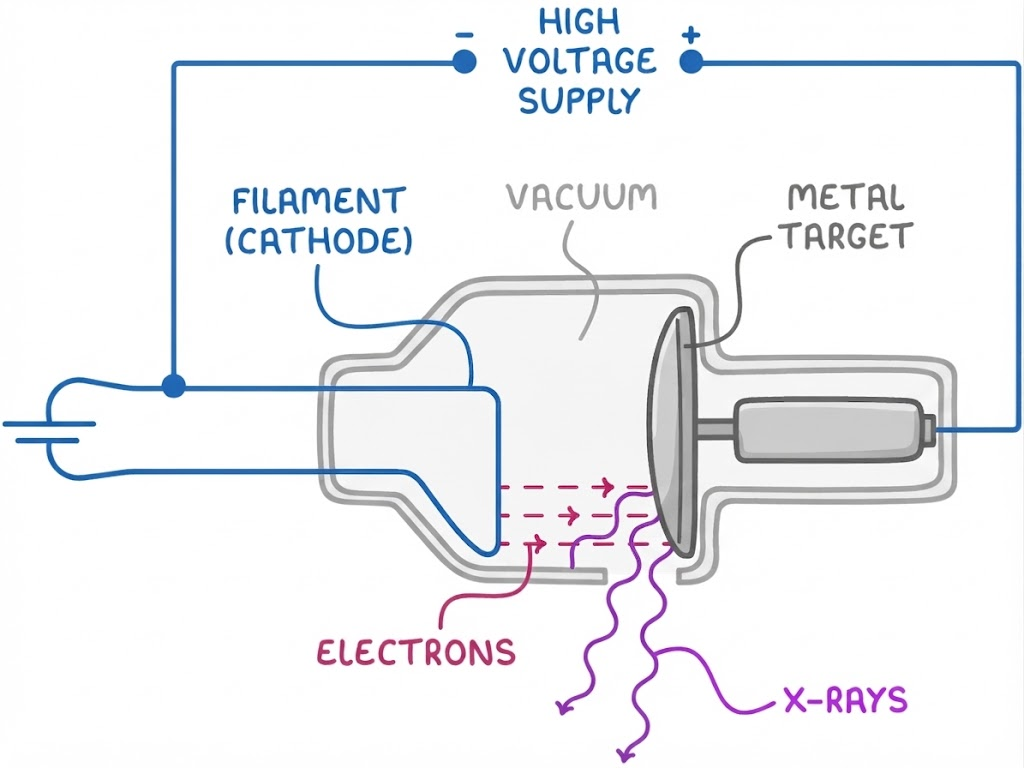
X-ray tube setup
Generation of X-rays in an X-ray tube
Electrons are emitted from the heated cathode by thermionic emission.
The electrons are accelerated towards the anode by a large potential difference.
Electrons bombard the metal target and decelerate.
Some of their kinetic energy is converted into energy of X-ray photons.
Minimum Wavelength
Maximum Energy Gained by Electrons
When an electron is accelerated across a potential difference V it gains kinetic energy equal to:
EK=eV
Minimum Wavelength of X-ray Photons
Since some of the kinetic energy of the electrons are converted into X-ray photons, the maximum energy an X-ray photon can have is equal to the maximum kinetic energy of the electrons:
λhc=eVλ=eVhc
X-ray Spectrum
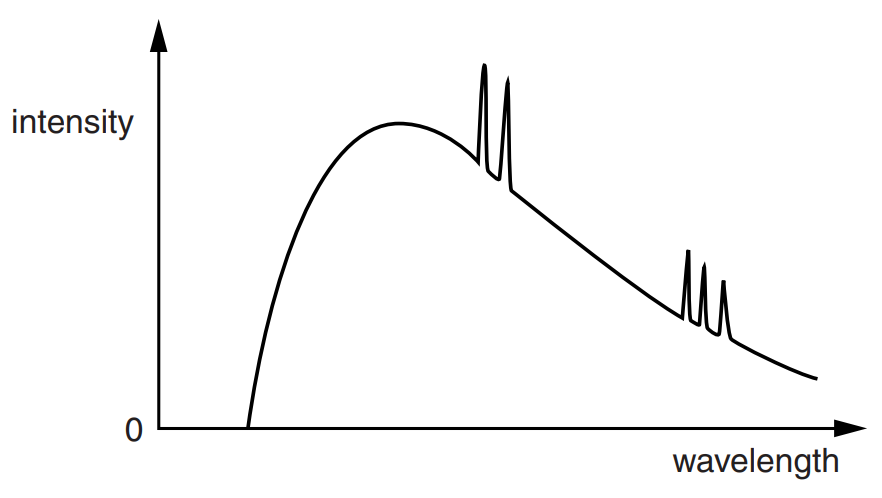
X-ray Emission Spectrum
X-ray spectrum
Continuous Distribution
An X-ray photon is produced when an electron is decelerated.
Larger acceleration results in larger photon energy.
Photon energy is related to wavelength
Electrons hitting the metal target have a continuous range of accelerations.
Therefore they produce a continuous spectrum of wavelengths.
Sharp cut-off at short wavelength
Electron gives all its energy to one photon and is stopped in a single collision
Superimposed Peaks on the Continuous Distribution of Wavelengths
De-excitation of orbital electrons in the metal target emit photons whose energy is equal to the difference in energy levels.