Annihilation
Definition: Annihilation
- Annihilation occurs when a particle interacts with its antiparticle.
- Mass-energy and momentum are conserved in the process.
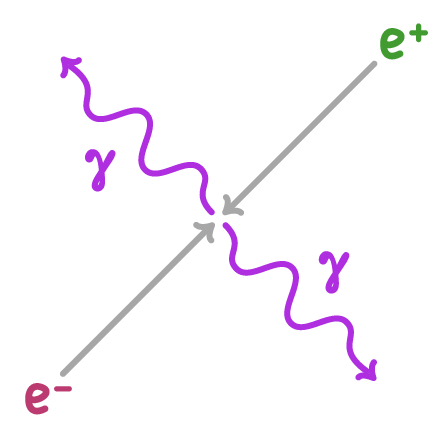
Positron and Electron Annihilation
- The positron emitted by the decay of a Fluorine-18 nuclide travels a very short distance before it collides with an electron.
- The positron and electron undergo pair annihilation.
- The particles disappear, releasing their combined mass-energy as photons.
- The mass of the electron and positron are converted into energy through the relation . -Assuming the electron and positron have negligible kinetic energy when they interact, the two photons appear with equal energies.
- The photons have frequencies in the gamma ray range.
- Assuming both particles were initially at rest before the collision, their initial momentum was negligible.
- To conserve momentum, two photons must be emitted in opposite directions.
Energy of Gamma Photons
Before Annihilation
- Positrons and Electrons have the same mass
- Their total mass is
After Annihilation
- The positron and electron no longer exist.
- Their combined mass is converted into photon energy.
Using the relation :
- Two photons are emitted in opposite directions in order to conserve momentum.
- The photons have the same energy.
The energy of one photon is therefore:
Frequency of Photon
Using :
Momentum of Photon
Using