Here are your comprehensive, high-quality revision notes for Cambridge AS & A Level Physics (9702) - Chapter 7: Waves. These notes are formatted for Obsidian and incorporate all syllabus points, worksheet insights, and the requested diagrams.
Chapter 7: Waves
7.1 Progressive Waves
Wave Motion & Energy Transfer
A progressive wave transfers energy from one place to another without transferring matter. The particles in the medium simply oscillate back and forth about fixed equilibrium positions.
- Mechanical Waves: Require a medium to travel through (e.g., sound waves, water waves, waves on a string).
- Electromagnetic Waves: Can travel through a vacuum (e.g., light, X-rays).
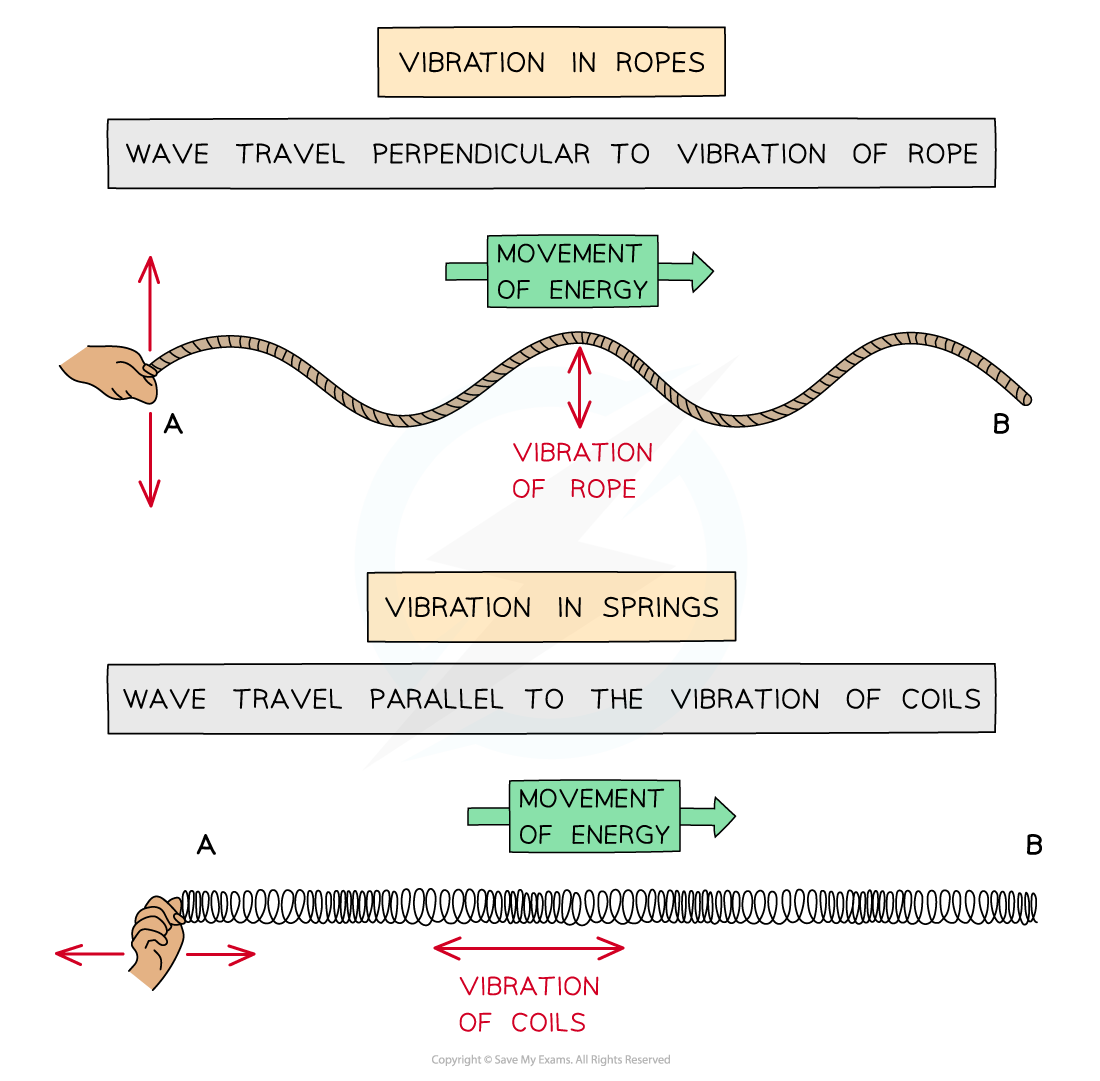
Wave motion can be demonstrated visually in laboratories:
- Vibration in Ropes: Flickening a rope up and down creates a transverse wave.
- Vibration in Springs (Slinky): Pushing and pulling a spring horizontally creates a longitudinal wave.
- Ripple Tanks: A vibrating paddle creates transverse water waves. These can be used to study reflection, refraction, and diffraction using shadows projected onto a screen beneath the tank.
Key Wave Properties
Definition Checklist
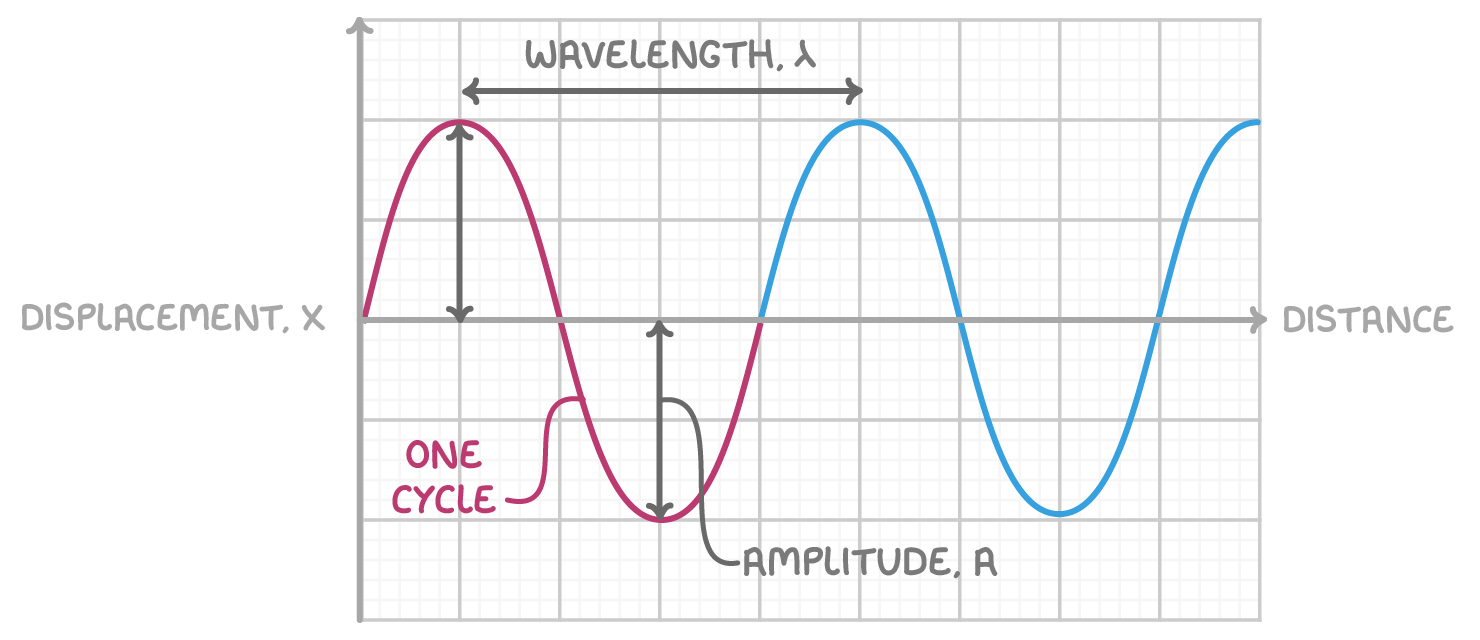
- Displacement (): The distance of a point on the wave from its equilibrium position. It is a vector quantity (can be positive or negative).
- Amplitude (): The maximum displacement of a particle in the wave from its equilibrium position.
- Period (): The time taken for one complete oscillation or wave cycle (measured in seconds, ).
- Frequency (): The number of complete oscillations passing a point per unit time (measured in Hertz, , or ).
- Wavelength (): The minimum distance between two points on the wave that are oscillating exactly in phase (e.g., peak to peak).
- Wave Speed (): The distance travelled by the wave energy per unit time ().
Phase Difference
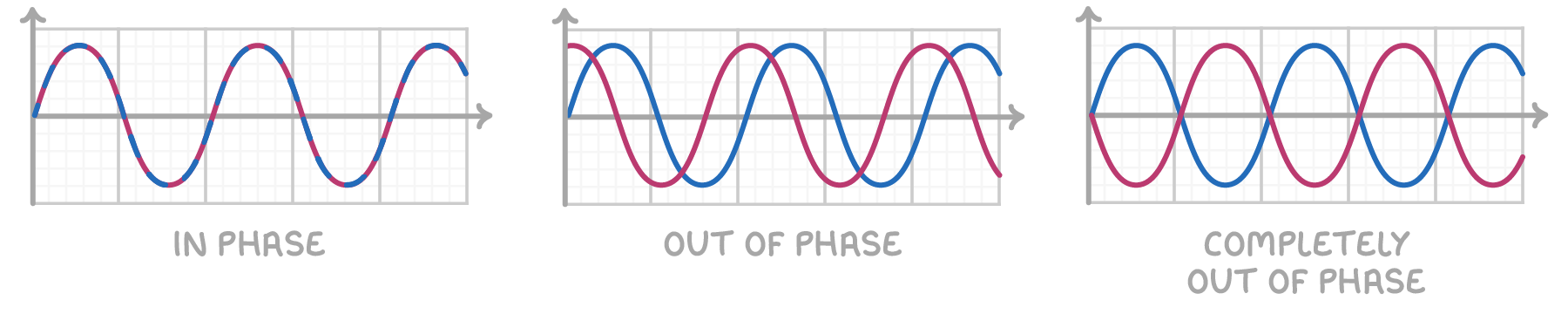
Phase difference tells us how much a point or a wave is in front of, or behind, another. It is measured in degrees, radians, or fractions of a wavelength ().
- In phase: Particles are at the same point in their cycle (e.g., two crests). Phase difference = , or .
- Anti-phase: Particles are moving in exactly opposite directions. Phase difference = , or (equivalent to ).
Deriving the Wave Equation
By using the standard equation for speed: If we consider one complete wave cycle, the distance travelled is the wavelength () and the time taken is the period (). Since , we can substitute frequency into the equation to get the Wave Equation:
Using a Cathode-Ray Oscilloscope (CRO)
A CRO displays sound waves and alternating currents as a transverse trace on a screen.
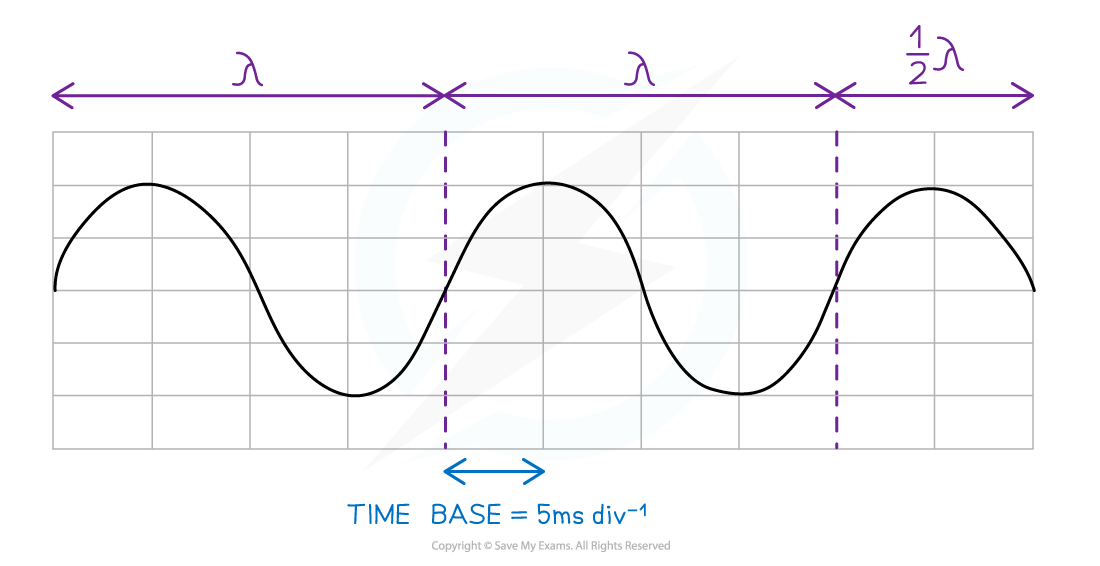
- Time-base (x-axis): Determines the time represented by each horizontal division (e.g., or ). It is used to find the Period () and thereby the frequency.
- Y-gain (y-axis): Determines the voltage represented by each vertical division (e.g., ). It is used to find the Amplitude.
💡 Examiner Tip - Finding Frequency from a CRO:
- Count the number of horizontal divisions for one full cycle (peak to peak).
- Multiply by the time-base setting to find the Period (). Be very careful with unit prefixes (e.g., convert ms to s).
- Use to find the frequency.
Wave Intensity
Intensity is the rate of energy transfer per unit area. It is defined as:
- Measured in Watts per square metre ().
- Inverse Square Law: For spherical waves spreading from a point source, the area is . Therefore, . If you double the distance from the source, the intensity drops to .
Intensity & Amplitude: The intensity of a progressive wave is directly proportional to the square of its amplitude (and the square of its frequency). (If the amplitude is halved, the intensity decreases by a factor of 4.)
7.2 Transverse and Longitudinal Waves
Comparing Wave Types
| Feature | Transverse Waves | Longitudinal Waves |
|---|---|---|
| Oscillations | Perpendicular () to the direction of energy transfer | Parallel to the direction of energy transfer |
| Structure | Made of Peaks and Troughs | Made of Compressions (high pressure/density) and Rarefactions (low pressure/density) |
| Vacuum | Electromagnetic waves can travel through a vacuum | Cannot travel through a vacuum (require a medium) |
| Polarisation | Can be polarised | Cannot be polarised |
| Examples | Light, ripples on water, S-waves | Sound, ultrasound, P-waves |
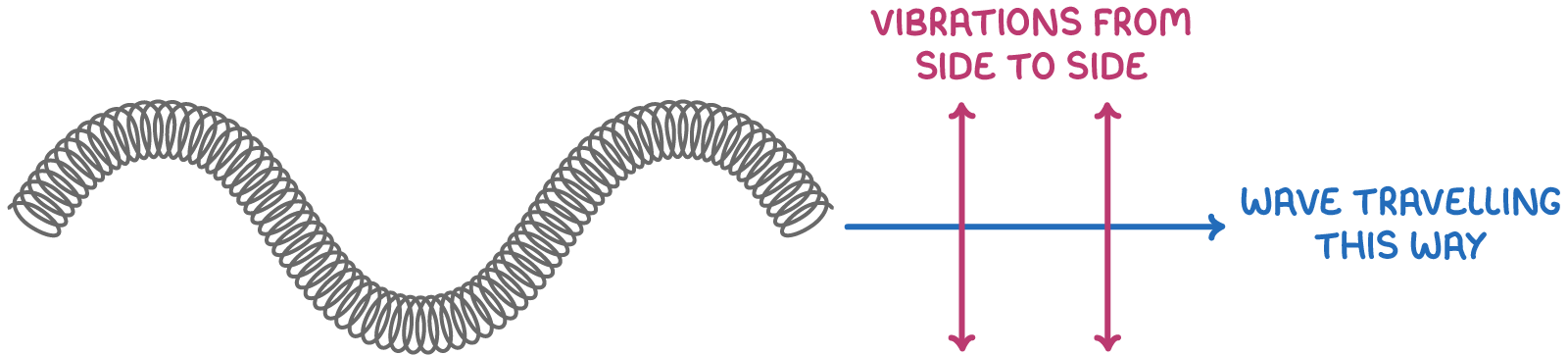
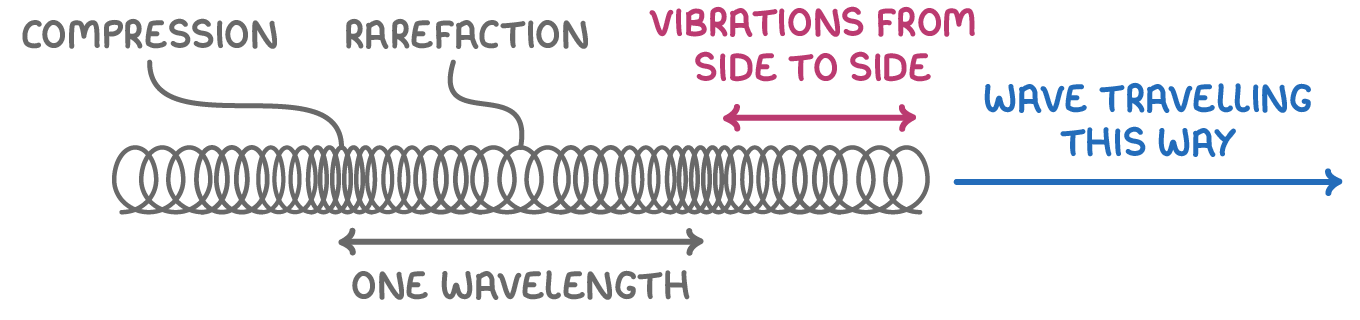
Graphical Representations
Both types of waves can be represented on graphs.
- Displacement-Distance Graph: A “snapshot” of the wave in space. The distance between two successive peaks is the wavelength ().
- Displacement-Time Graph: The motion of a single particle over time. The time between two successive peaks is the period ().
💡 Examiner Tip: Always check the x-axis of a wave graph! If it is distance, you can find the wavelength. If it is time, you can find the period. Never confuse the two!
7.3 Doppler Effect for Sound Waves
The Doppler effect is the apparent change in observed frequency and wavelength when a source of waves moves relative to a stationary observer.
- Moving Towards: Wavelengths bunch up (compress) Wavelength decreases, Frequency increases (higher pitch).
- Moving Away: Wavelengths stretch out Wavelength increases, Frequency decreases (lower pitch).
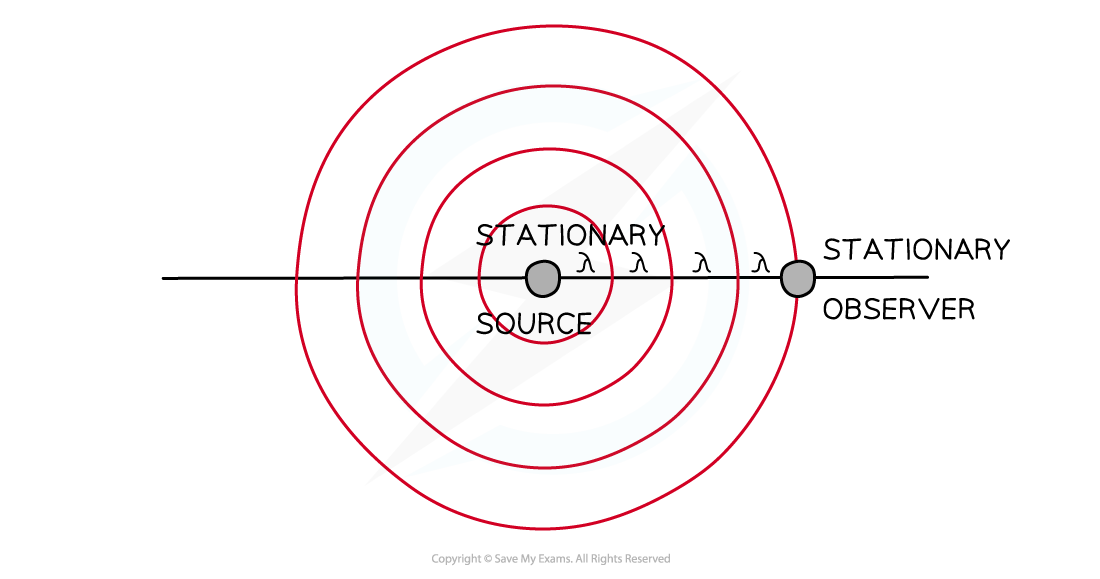
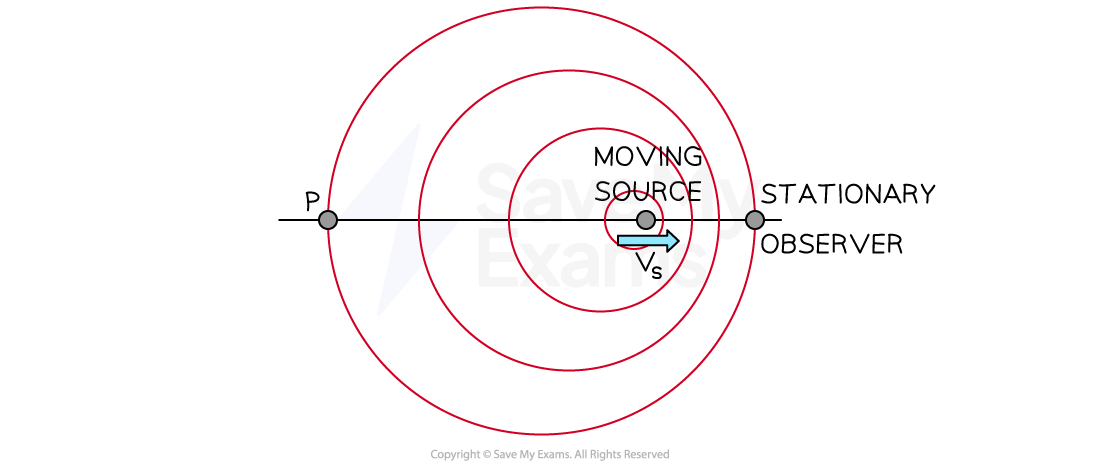
The Doppler Shift Equation
For a moving source and a stationary observer, the observed frequency () is calculated using: Where:
- = observed frequency ()
- = frequency of the source ()
- = speed of the wave in the medium (e.g., speed of sound )
- = speed of the source relative to the observer ()
Sign Convention ():
- Use minus () if the source is moving towards the observer (denominator gets smaller, making larger).
- Use plus () if the source is moving away from the observer (denominator gets larger, making smaller).
7.4 Electromagnetic Spectrum
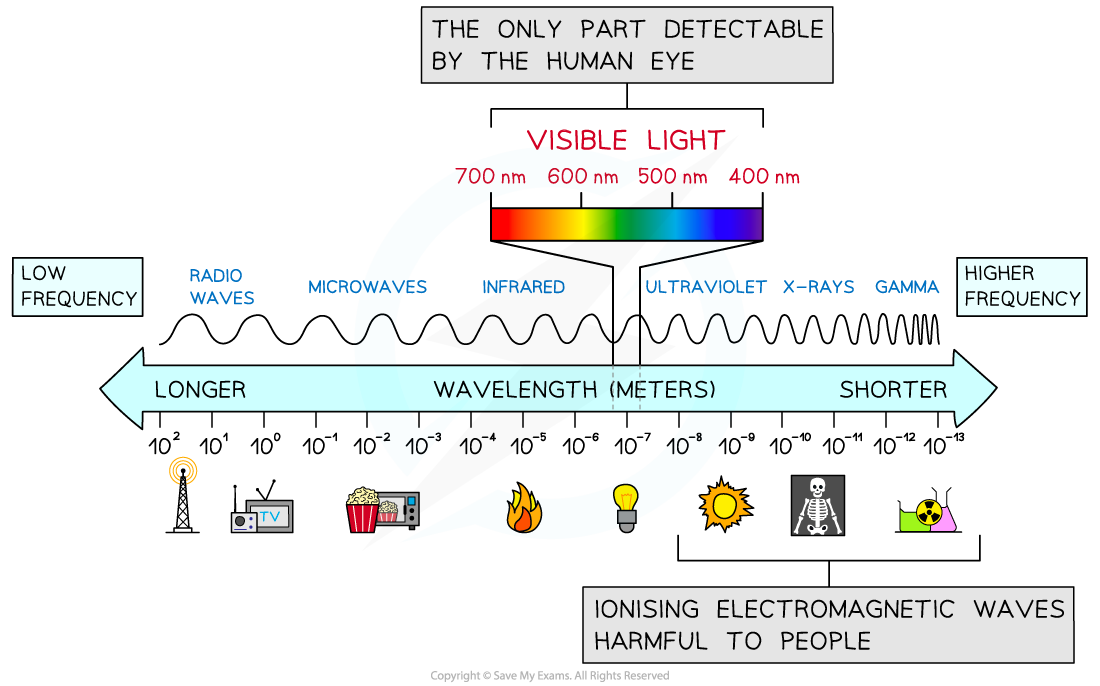
All electromagnetic (EM) waves share the following properties:
- They are all transverse waves consisting of oscillating electric and magnetic fields.
- They travel at the same speed in a vacuum (free space), known as .
- They can travel through a vacuum (do not require a medium).
Wavelength Ranges
You must memorize the approximate order and wavelength bounds of the EM spectrum in free space:
| Region | Approximate Wavelength Range () |
|---|---|
| Radio Waves | |
| Microwaves | |
| Infrared (IR) | |
| Visible Light | (700 nm to 400 nm) |
| Ultraviolet (UV) | |
| X-rays | |
| Gamma () rays | (Overlaps with X-rays) |
💡 Examiner Tip: You only need to memorize the wavelengths. If an exam question asks for a frequency range, quickly calculate it using where .
7.5 Polarisation
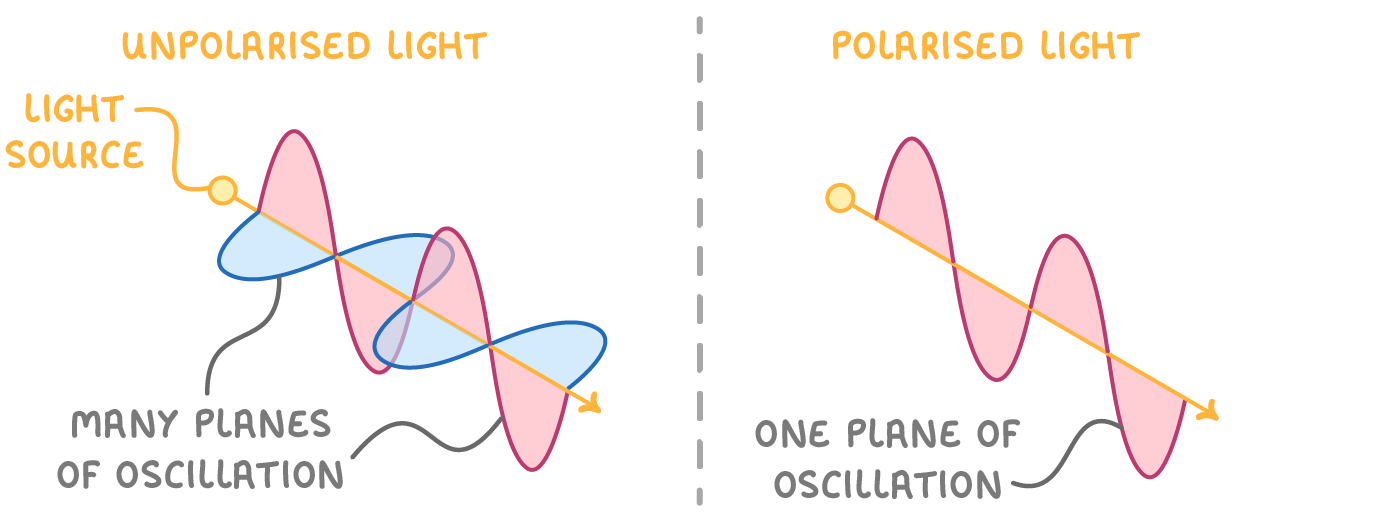
Polarisation is a phenomenon that only occurs in transverse waves. It is proof that a wave is transverse (e.g., light can be polarised, sound cannot).
- Unpolarised wave: Oscillates in all planes perpendicular to the direction of propagation.
- Polarised wave: Oscillations are restricted to a single plane.
Polarisers and Analysers
A polarising filter acts like a slit, only allowing wave oscillations parallel to its “transmission axis” to pass through.
- When unpolarised light passes through an initial polariser, it becomes plane-polarised, and its intensity strictly halves: .
- A second polarising filter placed in the path of already polarised light is called an analyser.
- If the analyser is rotated relative to the first polariser (crossed polarisers), no light is transmitted ().

Malus’s Law
To calculate the intensity of a plane-polarised electromagnetic wave after it transmits through an analyser, we use Malus’s Law: Where:
- = Transmitted intensity
- = Initial intensity of the already polarised incident wave
- = Angle between the transmission axis of the polariser and the plane of polarisation of the incident wave.
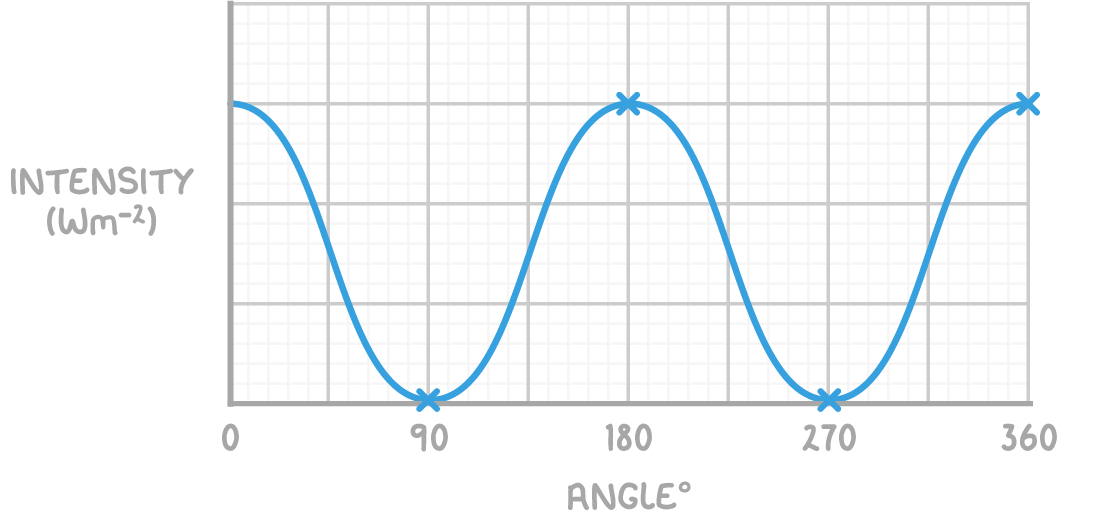
💡 Examiner Tip on Malus’s Law: Read the question carefully! Does it start with unpolarised light or polarised light? If the light starts unpolarised, remember to halve its intensity as it goes through the first filter. You only apply for the second filter (the analyser).