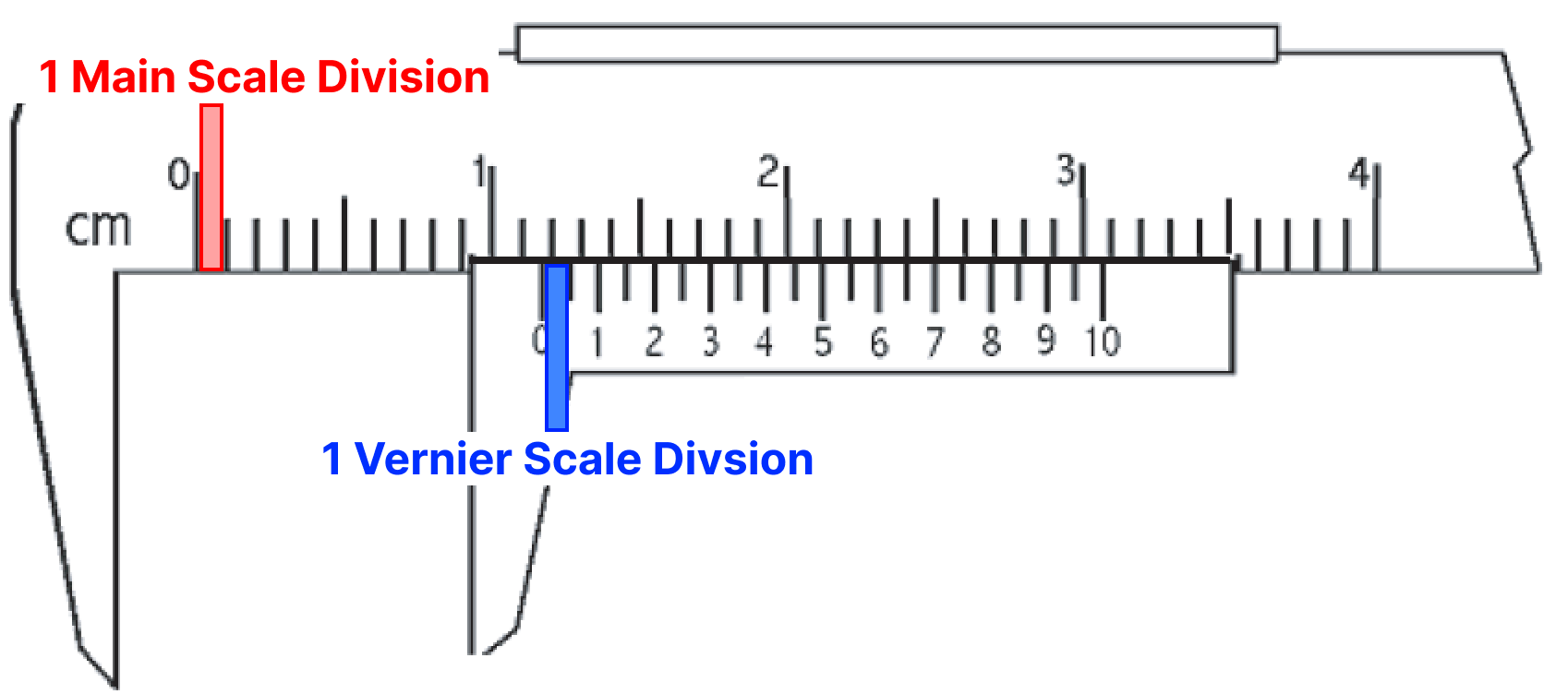
The precision (smallest possible measurement) can be determined using the following method:Precision=Total Number of Vernier Scale DivisionsValue of 1 Main Scale Division
Example
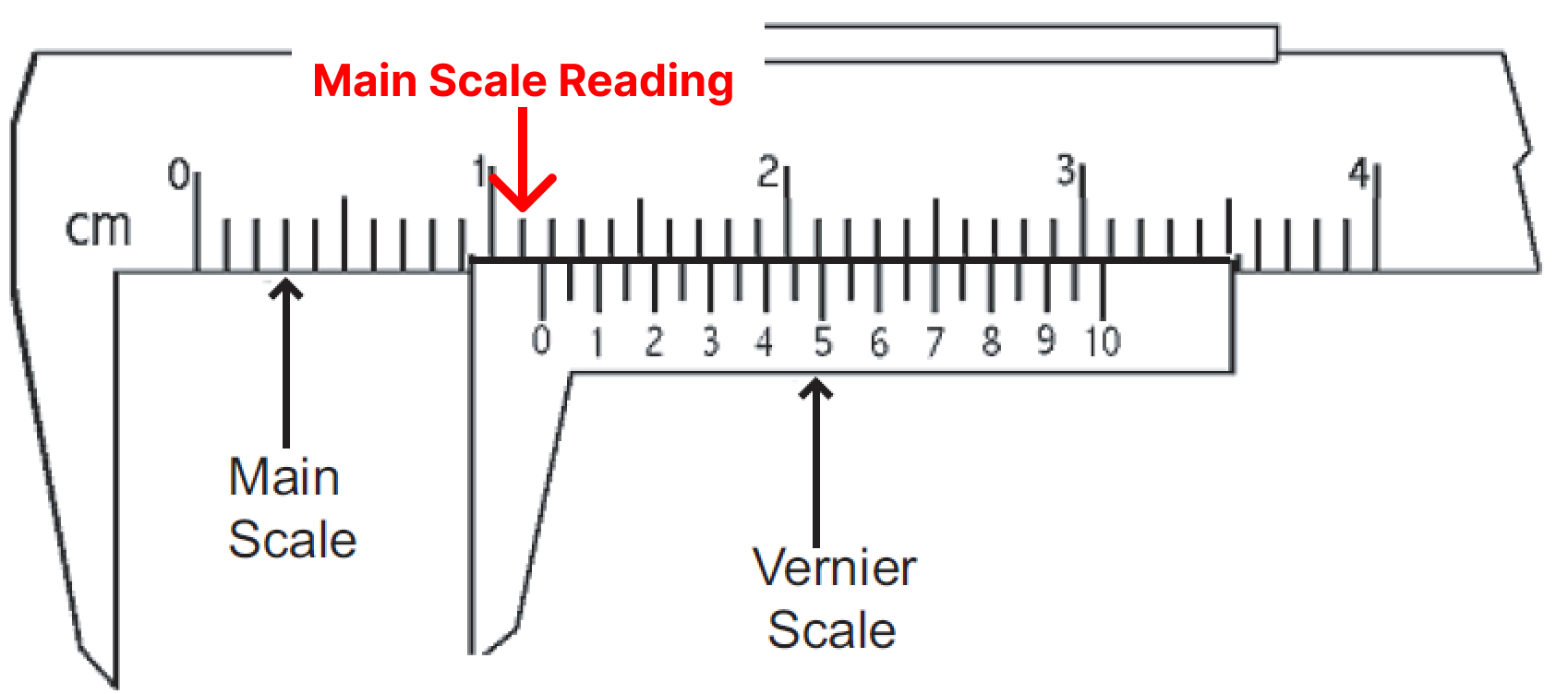
Example of a Main Scale and Vernier Scale
In this case:
Value of 1 Main Scale Division: 1 mm
Total Number of Vernier Scale Divisions: 20
Precision:Precision=201 mm=0.05 mm(0.005 cm)
Making a Measurement
Step 1: Main Scale Reading
The Main Scale Reading (MSR) is the main scale division just before the zero (0) mark on the vernier scale
Main Scale Reading
In this case, the Main Scale Reading (MSR) is 11 mm.
Step 2: Vernier Scale Reading
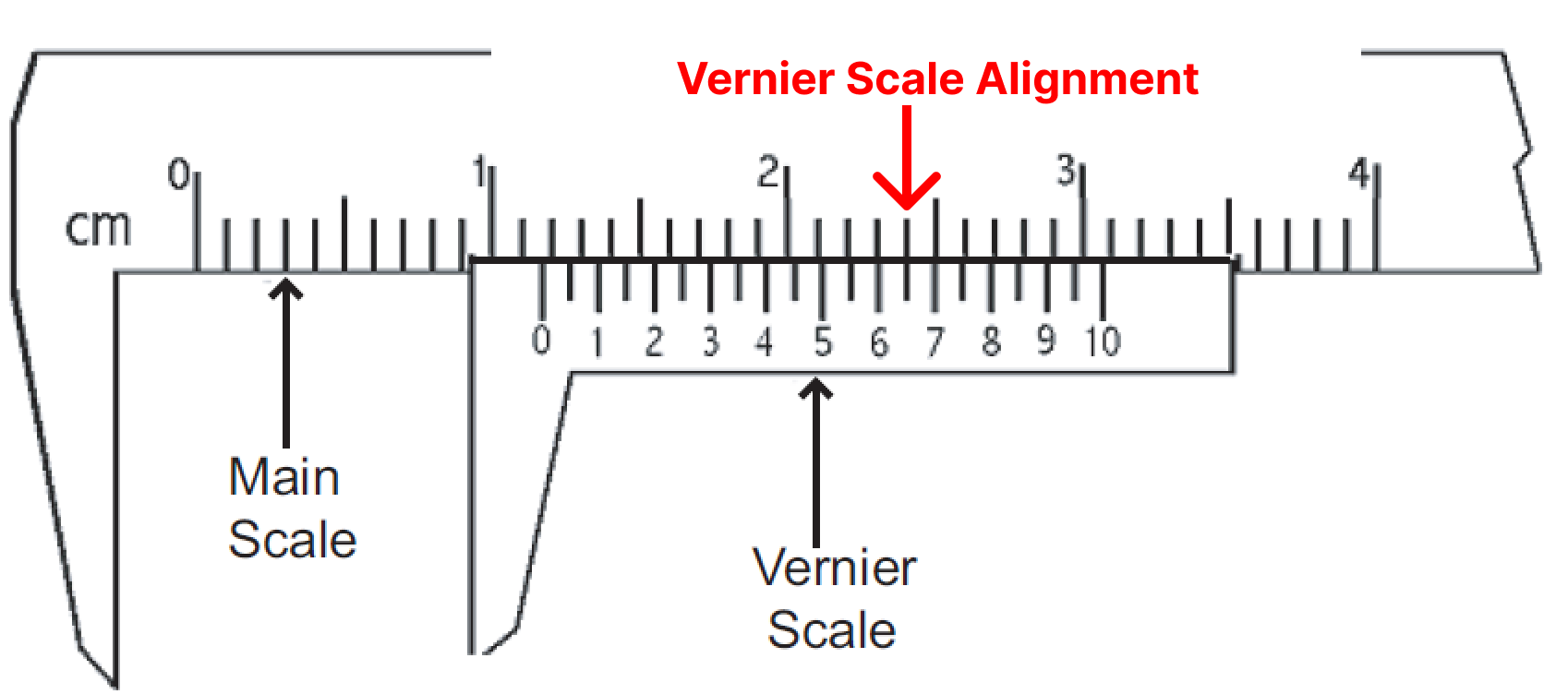
Identify the line on the vernier scale that is exactly aligned with a division on the main scale.
Count on the vernier scale the number (n) of that line from the zero mark.
The vernier scale reading VSR is given by:
VSR=Precision×n
Vernier Scale Reading
In this case, n=13 and Precision=0.05 mm:
VSR=0.05×13=0.65 mm
Step 3: Final Reading
The final reading is given by MSR+VSR
In this case, 11 mm+0.65 mm=11.65 mm
Recording Measurements
Important
Number of decimal places depends on the unit used to record the value.
To find correct number of decimal places, convert the precision that was calculated in mm into the desired unit and count number of decimal places.
Example
If recording in millimetres (mm):0.05 mm÷1=0.05(2 decimal places)If recording in centimetres (cm):0.05 mm÷10=0.005(3 decimal places)If recording in metres (m):0.05 mm÷1000=0.00005(5 decimal places)