If the transfer happens very quickly it is effectively negligible
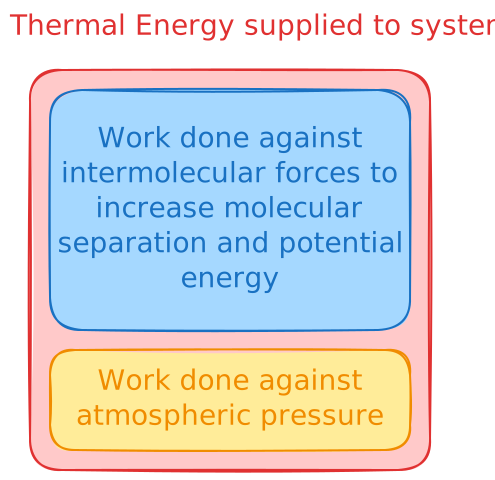
Thermal energy supplied > work done against atmospheric pressure
thermal-energy-split
Work Done
Work done on system to increase molecular spacing
Work done by system against atmospheric pressure
Applications
Use the first law of thermodynamics to explain why a bicycle pump gets hot when it is used to pump up a tyre quickly. [3]
Thermal energy transferred from system is negligible due to lack of time.
Work is done on gas to compress it
Internal energy increases so temperature increases
With reference to molecular energies, explain why the temperature of water remains at 100 °C when it vaporises in a kettle, even though it is being heated. [3]
During vaporisation molecular spacing increases
Thermal energy supplied is used by molecules to do work against intermolecular forces which increases potential energy.
Kinetic energy of molecules is unchanged so temperature is unchanged
Explain why, for a substance, the specific latent heat of vaporisation is usually greater than the specific latent heat of fusion. [3]
Vaporisation involves a greater change in volume
More work is done against intermolecular forces to separate molecules
Potential energy increases more while kinetic energy remains constant
So ΔU is greater
More work is done by molecules against atmospheric pressure
Since q=ΔU+work done by system, more thermal energy must be supplied
With reference to molecular kinetic and potential energies, describe and explain how the internal energy of the system changes when a gas is heated at constant volume so that its temperature increases. [3]
At constant volume molecular separation is constant so potential energy is constant
Since temperature increases kinetic energy of molecules increases
Since Internal energy = sum of kinetic and potential energies of all molecules, internal energy increases
With reference to molecular kinetic and potential energies, describe and explain how the internal energy of the system changes when a wire is stretched within its elastic limit at constant temperature. [3]
Since temperature is constant, kinetic energy is constant
Molecular spacing increases therefore potential energy increases
Since internal energy = sum of kinetic and potential energies of all molecules the internal energy increases
Use the first law of thermodynamics to explain what happens to the internal energy of a sample of water when it evaporates from a rain puddle on a hot day. [3]
The system is the evaporated water
Thermal energy is transferred to the water
Work is done by the water molecules against atmospheric pressure
More thermal energy transferred than work done so internal energy increases
Use the first law of thermodynamics to suggest, with a reason, how the specific latent heat of vaporisation of water at a pressure greater than atmospheric pressure compares with its value at atmospheric pressure. [2]